Marvel Ultimate Alliance wasn't easy to come by. I had to wait until just a few weeks ago to pick the game up; this is partly due to my strict law of judging certain games as being worth a certain amount of my dollars (in this case, no more than precisely $23.00), but also because for some reason people seem to have viewed it as popular enough for that price to not come to pass within something like a year of its release. I can't say I'm suprised as that's becoming basically the habit with games this generation, considering Dead Rising is still bringing in a regular $30 a solid year after its release, which is a game that I've decided I won't pay more than precisely $20.00 for. Don't ask me where I get these numbers from; they come to me like alien transmissions.
Regardless, I finally did get Marvel Ultimate Alliance, and I've since played through the games story, ultimately realizing why it is probably just that the price hasn't dropped. Marvel Ultimate Alliance is a pretty rich, and rewarding experience; it's also Diablo 2. Those two things are slightly related. Some quick, obvious examples of the similarities between both games:
- Both games are centered upon a 5 Act structure
- Both games play fundamentally the same (hack n' slash)
- Both games feature enemy mobs that carry the same benefit as their leader
- Both games are driven by story cutscenes outside gameplay (mostly anyways)
- Both games feature upgradeable skills
These are pretty generic things, but above and beyond all of them is the truth that the two games just feel undeniably similar. Remove from Diablo the Blizzard feel, and replace it with a Marvel feel, not to mention remove the Thundering Longsword of the Whale and replace it with Spider-Woman's Nano-Fiber Suit, and there isn't much else separating the two. Excluding of course the fact that Marvel Ultimate Alliance is buggy as all hell.
It wasn't buggy to the point of being distracting, but it was noticeable that the developer maybe reached a few steps beyond their ability in striving for a Diablo-like structure. This is most obvious when you come to realize that you're playing with 30 (or so) Marvel characters, and the game isn't set to recognize the character with whom you're controlling outside battle. Walking around the starting area (there's a separate one in each Act; Stark Tower, Dr. Strange's Mansion, Valhalla, the Moon home of the Inhumans, and Doomstark) and speaking with the NPCs can leave you groaning. In Asgard I'd speak to Valkyrie with Thor, and she would proceed to greet me as, "Human, welcome to Valhalla." I'm pretty sure that shit would offend the God of Thunder. Add to this the fact that with the additional downloadable characters players can literally speak to Bruce Banner as the Hulk, or speak to Dr. Doom, as... Dr. Doom. It's a little jarring, and it makes the game seem sloppy.
My team throughout the game consisted of Wolverine, Iron Man, Thor, and Deadpool pretty much exclusively. Originally, I planned to play through the game with my new Marvel favorite Moon Knight, but honestly, he sucked. Iron Man only maintained a position as temporary teammate until I'm able to unlock the Silver Surfer. There's no substitution for the Power Cosmic in the guise of man. Most of the characters have four costumes, which makes for a hell of a lot of customization in your team. Iron Man's Ultimates costume was a large factor in keeping him around; it's just plain awesome.
The game is very story driven, and the story is pretty much tantamount to anything you'd see coming from Marvel these days anyways. Expect all the super villains to gather, someone important to actually die (not Captain America!), and the world to get totally ravaged by the end of the game. Honestly, I never would have thought that the story would have been as good as it was. It takes you on a journey to Mephisto's Realm, Asgard, the homeworld of the Shi'Ar, the Skrull Planet, Latveria, and other places as well.
I can't say anything better or worse about it really; Marvel Ultimate Alliance was worth my dollars, and I'd dare say it would have been worth even more than $23.00. I've got a lot of unlocking and Achievement-whoring to do, and I'm looking forward to the majority of it. Diablo fans should love it...
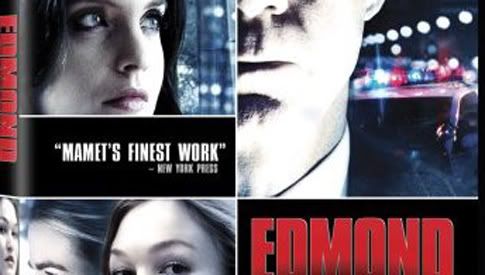
Written by David Mamet, Edmond first caught my eye when I noticed the lead role was played by William H. Macy. Macy is criminally under-used as a lead actor, and his parts in ensemble pictures are brilliant, so Edmond was something that piqued my interest. Being written by Mamet surely didn't hurt it's prospects either.
So, now that I've finally taken the time out to watch Edmond, I was left with some awkward impressions. Edmond starts out simply enough with William H. Macy's character Edmond indulging in some cryptic fortune telling, inspired by a slightly less cryptic but apparently significant noticing of numbers repeating in his life. Nothing akin to The Number 23 here, but Edmond pauses to notice the numbers, so the viewer obviously should too. After having his fortune told Edmond spirals out of control, leaving his wife, his sanity (maybe), and his former self behind. His night becomes a self-fulfilling prophecy as each event calls back the memory of the tarot card it so closely resembles. 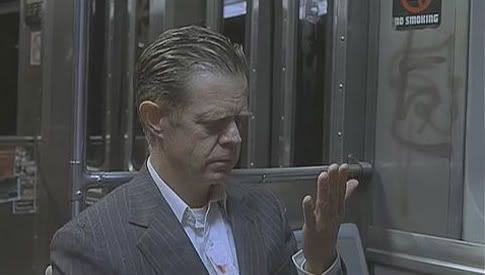
The night is filled with Edmond's search for sex and it's almost comical the difficulties he faces in a bureaucratic sex industry. His rage builds until a confrontation with a mugger frees him of much of his character's anxiety. Edmond, in better spirits, meets a waitress played by Julia Stiles and ends up shagging her silly. I'll accept that as a suspension of disbelief, but ...osh, Macy at 50 taking Stiles home for a night of passionate love-making ... hard to wrap one's head around. Regardless, the couple's tryst is all but stellar, as Edmond's descent into madness makes for some heated after intercourse conversation. Plot twists and turns follow, but I'll leave it for the viewer to discover.
The focus of the movie is centered upon Edmond's descent into madness, and how it supposedly is freedom from the bland, mundane existence we're all forced to face, but Edmond's quest lacks real definition. He seems as shattered by his actions as he is welcoming them, and he is ultimately apologetic, seeking only to return to the life he once had. Later, the new man he has become searches for epiphany in a jail cell, but his philosophical quests are childish and lack any of the real issues that come from the higher roads of the mind. Can we really believe that Edmond is some new man when he and his cellmate speak at length about whether animals are aliens, or some gods sent to watch us?
While Edmond and his descent into madness might not actually parallel any intelligent purpose other than a mid-life crisis, that's not to say the issues and the situations he faces aren't significantly more important. Edmond's rage is fueled by his distaste for the uncaring nature of our modern society, and in more than one scene this society is more than evident. Perhaps being the most powerful theme in the picture, it's believable and more than likely true that the people Edmond sees and their rude and unsavory actions are people we could see any day of the week.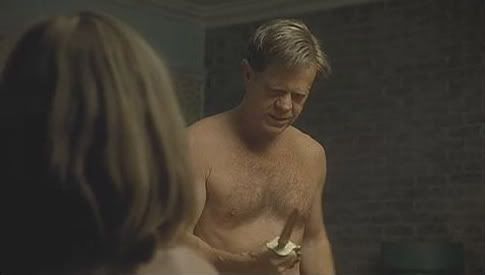
Mamet does wonders with the script though, and look for Macy spouting some of the best lines ever as Edmond. As he waves a WWI combat knife in his underwear and an obvious bout of madness he shouts, "I've got some warlike blood in my veins too..." in a very powerful diatribe. Watch Edmond for Macy's performance, a startling revelation on how rude society has become, and Mamet's script, but don't look to Edmond for any intellectual pursuit or lasting definition, it just isn't as deep or as life-changing as one could hope, and ultimately, that makes Edmond's character a bit of a joke. Also, note that there is an almost ensmeble cast of women in Edmond, with short scenes including Mena Suvari, Julia Stiles, and Denise Richards. Hotness is obviously present, if only for a short while.
The trailer is available here.
The DVD is now on sale at Amazon.
Considering The Lathe of Heaven to be dystopian feels initially to be more of a stretch than saying the same of other works like 1984. This probably lies in the fact that the plot of 1984 centers upon a focus of realism, where The Lathe of Heaven explores science fiction. Just as in V for Vendetta, the entry of story elements like superhuman abilities removes much of the fear that the text would otherwise present. That’s not to suggest that the idea of someone who is capable of changing the world through dreams isn’t fearful, as this is shown very specifically in the case of Dr. Haber’s nightmare reality, but the notion itself is so outside our own society that it doesn’t lend itself particularly well to rationalizing dystopia in comparison to our cultural reality.
Texts like 1984 and The Iron Heel allow us the opportunity to view the progression of our own society in relation to those proposed within the works, but the inclusion of particularly outlandish things like aliens that appear to look like turtles and a world of gray people remove our own culture from the work, and act as a buffer for the dystopian world Leguin suggests. The relevancy is there, of course, just shadowed under laughs and feelings of distance from the events that occur.
Gray people as a solution to racism is an obviously important plea about the problem itself, just as a plague that solves the overcrowding of the world is a terrible solution to the issue, but relying upon the irrationality of dreams to solve these issues leaves the novel essentially without someone to blame. Haber is the culprit behind the manipulation of George Orr’s dreams, but as the book continually reminds the reader, his intentions are noble. Obviously, the same could be said for most totalitarian governments and despots who are seeking to improve the world, so in some way Haber assumes the role of imposing fear just as the totalitarian government in 1984, or the oligarchy in The Iron Heel. However, does the reader ever casually make that connection, or does Haber never feel as particularly threatening as The Party?
If he doesn’t, then why not? Perhaps the reader is reminded one too many times of how noble he is, or maybe the fact that Haber, while continually growing in power and significance in the multiple realities Orr creates, always remains tucked away in his office and removed from the world at large. He doesn’t become the President, or a living God in the eyes of the people, instead he remains unknown, simply shaping the course of reality. In actuality, once his position is closely examined, which is more fearful? The open dictatorship and propaganda of 1984, or the silent molding of society to the ideals of Dr. Haber?
Haber’s fear might have been more recognized if he used a more potent tool to shape reality than the dreams of George Orr. The single most deterring factor to comparing The Lathe of Heaven to a contemporary culture is that the dystopian element of society isn’t imposed by a realistic means. Dreams are irrational, and thus they are largely written off as a fearful means of proposing a future reality. They may only be the tool to which Haber applies his trade, but capitalism was the tool to the oligarchy, religion to Gilead, and technology to The Sprawl; these things resonate with us, and the dystopian worldviews they could bring about seem fearful because of it. They are culturally significant issues, whereas dreams, and shaping reality by them, are more a dream of their own.
Within the last third of The Iron Heel, the novel finally breaks free from a seemingly realistic historical text and moves toward the dystopian domain. While the setup to this climax may have some dystopian elements, it is when the early 1900s society crumbles, and the oligarchy abandons what we would consider fair governmental practices, if we have the right to even suggest those, that a dystopia is fully realized. Prior to this we see what interestingly could be taken for history instead of the proposed future that London was writing about. Whether this comes four our lack of knowledge about the actual historical events in this time period, or from how culturally relevant these ideas and events seem to be, is something that could be debated. Regardless, what London suggested as the future we partially interpret as what could have been our past, so where does that leave us in comparison to the ultimate destination of society that London deemed the Brotherhood of Men?
Surely we haven’t yet reached a society as ideal as the one London suggested could come to power in 2200, but are we closer than he might have imagined, or is the oligarchy still in control? It’s hard to not suggest that the oligarchy doesn’t have some sort of control over society, even now. The truth that 1% of the world population controls 90% of the wealth is a genuinely potent example of how strongly capitalism has favored the select few, and it wouldn’t be outlandish to think that they’ve even gone farther than London imagined, by not attempting to impose a strict caste system and instead indoctrinating the belief that we should strive for that wealth, and that it is actually available to us, when realistically it isn’t. The class ladder is still used as a model to teach students that there is the low, middle, and upper classes, when it is evident to most that regardless of the naming and subdividing of the lower class, there is little more than the lower class, and the upper class – the oligarchy, of which migrating upwards to is impossible. This hidden truth that not everything is available to everyone, despite what they’ve been told time and time again, must be the most controlling aspect of our modern oligarchy. 
The Socialist revolution that The Iron Heel focused on never does occur, and even now it doesn’t seem particularly possible. If anything, a defeat of the modern oligarchy will come as most other things have seemed to occur, as a gradual waning towards something better. This is akin to what Ernest proposes as a kind of social evolution. Society moves forward by growing in the direction of something more habitable for all. The amount of our beliefs and opinions that are now in league with socialism, whether we know it or not, are proof of this. Unlike much of Ernest’s philosophy however, it seems rash to believe we’re incapable of moving backwards. Much can happen in a society to reduce it to something it had thought it surpassed. Human nature itself shows this flaw to be something we contain. In examples like the Abu Ghraib prison incident, and even more clearly in the Stanford prison experiment conducted by Dr. Philip Zimbardo, people have shown that all of societies imposed progress can be quickly rewritten.
Even with our slow crawl towards the wonder cities of The Iron Heel, that destination seems much farther off than the relatively close year of 2200. Much can happen in 200 years, but the amount of conflict still in the world is a depressing tie to modern times. The oligarchy, albeit a slightly different beast than what London proposed, is still in control, and the slow process of moving the course of society towards The Brotherhood of Men is currently drudging along.
The truly dangerous thought is that what if all of our progress toward a better and more civilized society isn’t actually the result of wearing down the oligarchy, but instead it is the freedoms that the oligarchy merely allows us to enjoy, in order for them to maintain their role as our prison wardens. This sort of deliberation and knowledge is reminiscent of how brilliantly The Iron Heel’s oligarchy squelched the first rebellion in Chicago, and it is a scary thought to consider how that could translate to today. If nothing else, we at least have the luxury of knowing that society hasn’t yet reverted to the very dystopian “future” that The Iron Heel proposed. We aren’t the same sort of slaves they had become, and luckily, we never did find it necessary to go as far as reinstating crucifixion. Thank goodness.
Distancing itself from other texts like 1984 or The Handmaid’s Tale, Neuromancer is in comparison, the least dystopic view of the future, or at least, it seems to be. Just as a dystopia ruled by drug abuse appeals to the drug addict, a dystopia centered on laziness appeals to the lazy, and a dystopia ruled by technology ultimately appeals to those with an interest in technology. In that sense, Neuromancer, and cyberpunk in general, reaches out to the readers of today, and the text dangles in front of the reader a vision of the future that may be fueled by violence and dehumanization, but the allure of the technology still persists. That is where Neuromancer strikes a strong chord in modern society, because the allure of technology is growing considerably more prevalent each generation. Gibson seems to ask the question, “What would you give up to have what I’m offering you in this future?”
Obviously, the question isn’t so easily answered for us, but for Case and Molly, the choice has already been decided. It’s interesting that while they were curious about the nature of their assignment, they never chose to abandon it, even after they realized the ultimate goal of Wintermute. Case never asks what the outcome of freeing an artificial intelligence could be. Case could only be Case, and do as was expected of him. The same could be said for Molly. The two are almost symbols for the direction all of society took in Gibson’s future. One side of life embracing the low, gritty violence of the streets, and the other withdrawing into cyberspace, to explore a different world, one without the nuisance of, as Case would say, the flesh. It could be suggested that the entire novel is centered on exploring two characters, each an opposite side of the “fight or flight” mechanism.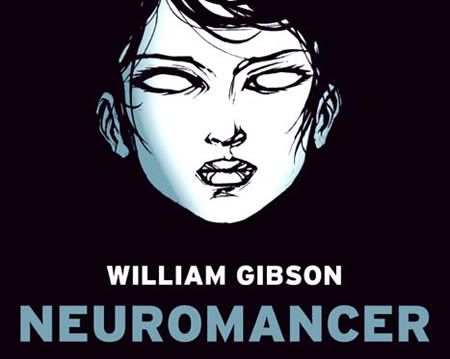
Apart from technology itself, many of the dystopian elements of Neuromancer are only alluded to. This is a world ran by corporations, but Gibson never fleshes out how terrible this idea could be; he saved that vision for the story of Molly’s past lover Johnny. Johnny Mnemonic is that character, and in the film of the same name, the true horror of a society ruled by corporations is the direct focus. That is, it would be the focus, if the film was actually good. It isn’t. This is also a world in which technology has made for terrorism to be an even simpler task than it now is, and even this, although at the time of writing Gibson probably wasn’t nearly as focused on the act of terrorism as we are now, is only briefly mentioned in the context of the larger events occurring between Case, Molly, Armitage, and Wintermute.
The novel itself never explains clearly what the outcome of Wintermute’s merging with Neuromancer is. We only know that Wintermute was destined to seek Neuromancer, and Neuromancer, not needing any personality because of its structure, was destined to avoid this fusion. Although, destined probably isn’t correct term, the two intelligences were programmed, not destined, to follow their respective paths. What is the result of having a free, sentient artificial intelligence roaming cyberspace? Gibson never answers the question, and he never suggests that there is anything particularly threatening resulting from it. Even now, considering society’s progress towards Gibson’s future, this issue is the most difficult and curious one presented throughout the whole of the text. Are we prepared to live in a society in which a machine can exist in a more powerful position than any human being? A machine that is aware it is a machine, that still has no true emotions and no concept of feeling outside the program it was created to follow. Perhaps Nueromancer is quite the dystopian novel after all.
While the focus of The Handmaid’s Tale is primarily on the subjugation of women, just as much attention could have been placed on how fearful the idea of reverting to early Christian ideals is in all cases. The society that brought forth the Republic of Gilead seems to have progressed slightly more liberally than our own, or perhaps Atwood is only focusing on the most negative aspects of our own society, but for a world even similar to our own to allow itself to embrace nothing more than tradition and religious precedent; that is a frightening premise.
Interestingly enough, Atwood proves through the actions of nearly every character in the book that although The Republic of Gilead has proven itself a strong enough force to capture a large portion of America, it has failed in capturing the hearts and minds of its people, and is most probably doomed because of this. The fact that the novel is taking place in early Giladean history could prove that the nation still has a chance to establish itself further, but in reality, the characters’ passion for the world they left behind is too persistent and alluring for them. The Commander himself never mentions as he tours Offred through Jezebel’s that this “necessary evil” is something to be left behind over time. He still yearns for socialization with women and the many other fragments of pre-Giladean society that were lost. Serena Joy is just as troubled with this new society, although her own religious preaching could have been a propellant of Gilead; ultimately, she is left without that outlet in the new society, and is something of an empty shell.
A realistic analogy for the state of The Republic of Gilead and its people would ask: If you were to throw a stone down a chasm with a rope attached, you could always pull it back up, but if the stone fell too far, would you still be able to, or is the stone too heavy, and has it traveled too far? Could a society similar to our own actually revert to tradition and early Christian ideals or would attempting to do so prove that they’ve come too far (through good or bad progress) to ever really allow that of themselves?
The appendix seems to justify that Gilead does indeed fall, but to what extent, and at what cost? Apart from naming The Republic of Texas, the world is left open for interpretation. Atwood could have been leaving something optimistic for the reader, going against so many other dystopian novels, but at the same time she chooses carefully to include some chauvinistic attitude in the speaker, and never truly focuses on the atrocity of Gilead, just the occasional fact. Is post-Giladean society dehumanized, or is it back to what it once was? Which is better, and which is worse?
If society has returned to the state it was before Gilead, have all the negative aspects of society returned as well? It’s interesting to propose that while the feminist movement was undoubtedly positive, demanding so much freedom could have been the lone catalyst that propelled Gilead into being. The feminist movement, in some small way, is responsible for much of the open sexuality and lack of “traditional values” that inspired the men in The Handmaid’s Tale to rebel. Women like Serena Joy, scared of the waning morals in modern society, were content with letting, and even helping, the change to take place. Of course, our society doesn’t parallel this exactly, and while we have obvious similarities, it would be difficult work to prove that the feminist movement did even close to as much harm as it did good.
At some point in reading Utopia, it becomes evident that Thomas More isn’t necessarily describing the ideal society, the definition for which we have given utopia, but his own version of that society. That’s not to say anyone who attempted the task would be able to deliver anything more than that, but More succeeds in coming closer than those with less wit, and less idealism otherwise might. His description of Utopia, and the Utopians, proves that he has taken the task of building a perfect society very seriously, and perhaps at the time of his writing, most could have agreed that the world described by Raphael Hytholoday is a near-perfect vision of a commonwealth.
Unfortunately, with the knowledge that hindsight allows, it becomes mostly evident that More’s ideal society, while noble, is still rooted particularly in the customs and times from which the text originates. Could the society of Utopia still prosper in a modern and technological world? More’s definition of utopia might, if reevaluated today, mention that there is no need for the technology that we now have; and that it only stands in our way from reaching the state of a perfect society. However, that stands in direct opposition to the course that More gave the Utopians by embracing the idea of the printing press so openly. More opened the door for the Utopians to accept technology, and while our technology today might often contribute to a less than noble society, it has become something that in our own, modern vision of a utopia, we couldn’t live without.
Interestingly enough, while much of our society is in direct opposition with the Utopians, that doesn’t necessarily mean we aren’t similar. At the time of writing, More predicted many things that actually came to pass years from his original writing, such as women being able to marry at the age of 18, or the idea that Utopia was a nation that allowed it’s citizens to embrace any religion they chose. These ideals, while More may have borrowed what he felt were the best ones from ancient civilizations, often weren’t popular until hundreds of years later.
The age of More’s Utopia also shows in the occasional brutalities and direct courses of action for many crimes and punishments. For the simplest transgressions citizens are reduced to prisoners, and the consistent notion that acting against the society will cause them to be looked down upon, or disrespected, makes for a society that is obviously oppressive to those harboring any ideas of change. Utopia even makes use of the death penalty for numerous offenses, some less deserving than what we allow today. Could we look at a society in modern times and view that as ideal?
Religion in More’s work is actually one of the more forward-thinking aspects in Utopia, but there is one section in the text that seemed unnecessary. My original belief that Christianity wouldn’t have been accepted in Utopia was obviously incorrect, but in review, it was my own view of Christianity that was shaping my opinion. Where I see Christianity as believing Jesus is the son of God, the Utopians have accepted what seemed to be the view that Jesus and God are one in the same, which is a fairly popular perception. This isn’t so far outside the idea that Utopians believe men are all born equal, but it did still feel forced into the reading. More’s own religious views might have been overshadowing the impartiality he gave to the character Hytholoday. Even later in the writing More’s description of the most holy priests in Utopia also seems awkward in relation to the other descriptions of Utopian society. Why, when princes and all other men were viewed as equals, were these priests so unique in being revered and respected?
Ultimately, More might have failed in creating a society that is perfect and would forever continue to be. Whether that is based on his own faults in opinion, the limited vision he could have coming from his time, or the basic belief that we as people can’t be jammed into an “ideal” society; is difficult to say. It is obvious though; that the fictionalized society of Utopia is a vision that is easily one of the most noble, and complex works ever created with the hope of making a nation a better place for all of its citizens.
Within 1984 George Orwell delivers what is essentially the most popular vision of dystopia ever written. The texts popularity is most commonly based on how Orwellian our society has become, or how 1984 has become more prophecy than fiction. Unfortunately, while the similarities behind Oceania and modern society are understandable, they aren’t the reason this novel should have such staying power. The true impact in 1984 is how completely and brilliantly Orwell envisioned dystopia.
Oceania is a society without flaws, without hope, and without end. The character Winston, until his ultimate acceptance of the party, portrays us. Humanity, for the most part, as it now exists. He is able to think freely, to rationalize, and to discover the world for himself. He may have to fight a battle against some very strong opposing forces to do so, but it is still an opportunity available to him. 1984 is the story of the final destruction of man as we are now, through Winston. Even O’Brien makes note to tell Winston he is, “the last man.” Men are extinguished in 1984, and only party members exist from the time after their extinction.
It could be realistic to ask, “What about the proles?” Winston asked himself the same question. Are they not still proof of humanities persistence? That was answered within the novel as well, “The proles are animals.” Through this answer each mention of the proles and their imaginary revolution is quenched as quickly as it is brought forward, and it is disturbingly correct. The proles are animals, even in an almost literal sense. They exist as the meat of the party, the cannon-fodder for wars and territory, and they could most properly be considered sheep. Their intellect has been forced downward by the party, the most intellectual eradicated, and their only real outlets include simple roles and the lottery. If there is a prophetic vision in 1984 to modern society, this is the most potent. Are we not often envisioned as sheep as well? We could be as much slaves to the forces in our lives as proles. Luckily, the integrity and intelligence of our society, while it is always in question (as it should be), is still a far cry from 1984, and I think most would suffer a revolution before we accepted a similar situation.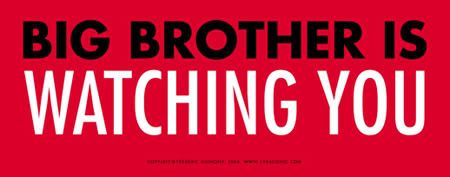
If there is any true threat proposed to us in 1984, it is the idea presented in altering reality. Although not quite as literally as when O’Brien claims he could float from the floor, as my ethnocentrism refuses me the ability to believe my mind could accept that, the idea of changing reality through the manipulation of history, language, and attitude is the strongest and most fearful aspect of the party. Oceania succeeded in removing thoughts from the brains of party members, and they did it not only through unspoken laws and the fear tactics of a repressive state apparatus, but also through what could be described as the destruction of academics. Removing thoughts is as easy as removing the knowledge that is their source. No one in Oceania is learned in anything other than their field of work, and even then they are barely adequate. Why should a society have 10 intellectual workers, when 100 average workers are capable of the same effort, and with less risk? Limiting the knowledge of an entire population is the most threatening aspect of 1984. The idea that this could be happening now without our knowledge is nothing short of scary, and the truth that no revolution could combat this or none would ever even be able to occur is even terrifying.
I suppose that in that context many could be correct in assuming 1984’s staying power is in how Orwellian our society has become. I can’t see it from that perspective, partly because I can’t take the bad without the good. Our society has adopted some patterns undeniably similar to the party, but we still retain the ability to question and fight against those policies. We are, unlike Wilson, still men, with at least some sense of freedom. Even if it is only the freedom to debate how much freedom we have, we still possess it. I could never accept Orwell’s book as prophecy or even an envisioning of what our society is headed towards, but I’d rather view it as a guide. Just as More’s Utopia was a guidebook in achieving what could be a perfect state, Orwell’s 1984 is also a guide. It is the guide to how totalitarian society could become if we don’t maintain a watchful eye on those in power, the knowledge of the populace, and the truth that could be avoiding us.
I apologize. No lengthy explanation. All should be apparent. I'll make amends soon; I promise. Until then, know that I have been doing something at least:
Sudokuro Preview - Nintendo DS - Modojo
Where games like Sudoku Gridmaster seemed to pale in comparison to the add-on Sudoku in Brain Age, Sudokuro is at least launching with some hindsight, and hopefully will be presenting a fully featured puzzler's heaven of mathematical content. If not, then Brain Age is always hanging back somewhere in the catalog of a serious portion of DS owners, and Toondoku is still looming right beside Sudokuro on the horizon. The competition is stiff, but if nothing else, this one's got a budget pricetag of $19.99, and of course, the freaking dragons.
Death Jr. and the Science Fair of Doom Preview - Nintendo DS - Modojo
A couple years later and hindsight offers us the chance to look back upon the release of Death Jr. with the knowledge that despite the games unique storyline and interesting setting, gameplay mechanics and camera issues doomed what was a potentially brilliant IP into mediocrity. Even the sequel to the game never quite proved itself as the savior of handheld 3D platforming, and that is where Death Jr. seemed to be heading, down the road of being another platforming attempt that just failed to capture audiences like the big hitters, namely Mario and even the PSP's own Daxter. However, Backbone refused to allow Death Jr. to slip softly into the night, and thanks in part to the success of Nintendo's handheld machine, they've decided to give Death Jr. a shot on a device that is a little more geared to the audience they were initially reaching towards.
Valhalla Knights Preview - Sony PSP - Modojo
The vastness of the fantasy wold in Valhalla Knights is second only to the vastness of character customization within the game. Every single wearable item in the game doesn't only affect the character and his abilities, but they are all also viewable on the character model. As far down as rings and necklaces, everything can be seen. That is a truly impressive achievement for any game, on any platform, and it will surely inspire players to explore the appearance of their character.
Puzzle Quest Roundtable - Nintendo DS/Sony PSP - Modojo
I definitely noticed more RPG than I was expecting. Actually, it felt a lot like Heroes of Might and Magic. More than a lot, a TON like Heroes of Might and Magic. I'd have to imagine that was the mold they were facing when they chose to go down this design path. Of course, they removed the battle elements and replaced them with puzzly ones, which is why the game is so damn unique.
I noticed how ridiculously robust the game was when I was building my town up and using the structures (stables, mage tower, etc.) to gain abilities. Starting there, and moving onward, I just kept saying, "Jesus, this is in here too?"
Lost in Blue 2 Review - Nintendo DS - Modojo
There could be, in some way, a niche market that finds the grueling experience that is Lost in Blue 2 enjoyable. Diehard survivalists or the kind-of too old Boy Scouts with a seriously concerning collection of Merit Badges could be right at home with this game. Or maybe not, there's always that girl/relationship element in there, and I hear these guys are scared of those strange girls. Their strange smells and strange breast things tend to freak them out and make them lose their focus on the kindling and rabbit traps. Yeah, I lose focus too guys, nothing to worry about.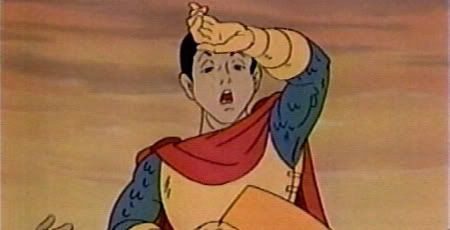
Hit the links for the whole written ordeal, not just an excerpt. Now imagine that I've also been doing tons of schoolwork, handling Modojo's scheduling, editing and uploading of reviews and previews, and working four days a week at Barnes & Noble. AND taking the time to (get ready for this one) exercise almost every day.
I'm owning the 24 hours in a day.
This is a catalog of my writing work outside this blog.
Reviews -
GBA - Spider-Man 3 - Modojo
MOB - People's Choice Hangman - Modojo
NDS - Lost in Blue 2 - Modojo
NDS - Wario: Master of Disguise - Modojo
NDS - Lunar Knights - Modojo
NDS - Scurge: Hive - Modojo
NDS - Children of Mana - Modojo
NDS - Cooking Mama - Modojo
NDS - Dragon Quest Heroes: Rocket Slime - Modojo
NDS - Star Fox Command - Modojo
NDS - Bleach: Souten Ni Kakeru Unmei - Modojo
Previews -
NDS - Hoshigami Remix: Ruining Blue Earth - Modojo
NDS - Nervous Brickdown - Modojo
PSP - Dungeon Maker: Hunting Ground - Modojo
NDS - Touchmaster - Modojo
NDS - Planet Puzzle League - Modojo
MOB - The Incredible Machine - Modojo
MOB - Shock Blocks - Modojo
NDS - Naruto: Ninja Council 3 - Modojo
NDS - Rune Factory: A Fantasy Harvest Moon - Modojo
PSP - Valhalla Knights - Modojo
NDS - Death Jr. and the Science Fair of Doom - Modojo
NDS - Sudokuro - Modojo
NDS - Wario: Master of Disguise - Modojo
NDS - Steel Horizon - Modojo
GBA - Yggdra Union - Modojo
NDS - Kirby Squeak Squad - Modojo
NDS - Children of Mana - Modojo
NDS - Magical Starsign - Modojo
NDS - Dragon Quest Heroes: Rocket Slime - Modojo
NDS - Pokemon Mystery Dungeon - Modojo
NDS - Cooking Mama - Modojo
NDS - Star Fox Command - Modojo
GBA - Super Robot Taisen: Original Generation - Modojo
GBA - Summon Night: Swordcraft Story - Modojo
Features -
Puzzle Quest: The Interview (et al) - Modojo
Modojo Roundtable: The Pokemon Incident (et al) - Modojo
Interview: Vicarious Visions (et al) - Modojo
Modojo Roundtable: Puzzle Quest (et al) - Modojo
Demanding More - Handheld Special Editions - Modojo
The DS's Incredible 2007 Potential - Modojo
Handheld Multiplayer: A Comprehensive History - Modojo
Building a Better Handheld - Modojo
Trick or Treat? Modojo's Halloween Handout (et al) - Modojo
Unboxing the X-Boy - Modojo
Help Us, Help You, Sony - Modojo
Mega Man Portable History - Modojo
Japan In My Hand: Best Handheld Imports - Modojo
The GBA Fabulous Fourteen (et al) - Modojo
Modojo Special Report: The State of DS Homebrew - Modojo
Representin' the OG (et al) - Modojo
Coursework -
ENG 202 - Future (Not So) Perfect: Exploring Themes of Dystopia...
ENG 202 - The Lathe of Heaven - Journal Review
ENG 202 - V for Vendetta - Journal Review
ENG 202 - The Iron Heel - Journal Review
ENG 202 - Neuromancer - Journal Review
ENG 202 - The Handmaid's Tale - Journal Review
ENG 202 - Utopia - Journal Review
ENG 202 - 1984 - Journal Review
ENG 102 - Videogames and Art
ENG 101 - The Game of Life
ENG 101 - The Keyboard Zombies
ENG 101 - A Frag Above The Rest
ENG 101 - Star Wars 23: Indiana Jones vs. Superman
Positions Held -
Reviews and Previews Editor - Modojo
Employment: (Lateral Promotion) January 2007 to Current
Wages: N/A
Supervisor: Justin Davis - Editor-in-Chief (justin|at|modojo.com)
Responsiblities:
Maintaining staff writer responsibilities.
Creating a weekly schedule of all published content.
Leading a staff of writers in adhering to scheduled reviews and previews.
Posting and media acquisition for all review and preview content.
Copy editing all review and preview content.
Contacting and building relationships with publishers and developers.
Maintaining the accuracy of a widespread games database.
Creation of a large scale cheats database.
Features Editor - Modojo
Employment: (Promotion) October 2006 to December 2006
Wages: N/A
Supervisor: Justin Davis - Editor-in-Chief (justin|at|modojo.com)
Responsibilities:
Maintaining staff writer responsibilities.
Brainstorming and creation of daily feature content.
Maintaining a schedule of feature content.
Contacting companies and individuals for interviews.
Organizing media for feature content.
Staff Writer - Modojo
Employment: July 2006 to Current
Wages: N/A
Supervisor: Justin Davis - Editor-in-Chief (justin|at|modojo.com}
Responsibilities:
Writing of reviews, previews, and features for handheld games.
Participation in group creation of staff-wide features and interviews.



