Decoding Year Zero: The Dystopian Alternate Reality
Written: May 3, 2007
The dystopian concept, present commonly in literature, has proven to be a pervasive notion that imposes itself through various forms of media. Dystopian reality has been explored through theater, radio dramatization, and has even lent itself particularly well to film. Each form of media carries with it the hurdles that dystopian concepts must leap, and in doing so, certain media has proven to be a fertile ground for highlighting and focusing on dystopian ideals. Radio dramatization, in the case of H.G. Wells’ War of the Worlds, suggested that dystopia, otherwise limited to the restrictive and specific nature of literature, can by exceeding that medium become a tool of panic and fear. Film then progressed the notion of dystopia using the visualization of supposed dystopian societies that would have been previously relegated to imagination and nightmare. Now, with the advent of digital delivery and media in a communal, online setting, dystopia has once again adopted itself into new media. The alternate reality game (ARG), a narrative structure defined by user participation and concepts including the hive-like organization of internet communities, has become the latest medium to propose dystopia. The Year Zero album from musical artist Nine Inch Nails has initiated the use of ARG, in conjunction with popular music, as a tool for creating a dystopian narrative structure. Year Zero has taken the necessary steps to prove that new media, and in particular, the interactive nature of the ARG, will be an evolution in the role of dystopia, and how potent and contemporarily significant a vision they are able to provide.
In order to better explore the way in which Year Zero and ARG’s enhance the role of dystopia, one should first consider the definition of an alternate reality game. The platform came to rise with The Beast, a viral marketing experiment conducted surrounding the 2001 film A.I. The credits to A.I. included a listing for a “Sentient Machine Therapist” named Jeanine Salla. This position being impossible to perform with current technology, sleuthing viewers performed internet searches to discover that Jeanine Salla was a worker of Bangalore World University, in the year 2142 (Hon). The comprehensive university website led to a series of other websites and telephone numbers that all suggested the topics contained within were consistent and real. These events propelled the community to interact with fictional characters, and in doing so the creators of the game responded by suggesting puzzles and possible actions that the community could take to ascertain the entire narrative. The entire course of the game expired, and over one million participants had been involved with the solving, discovering, or following of the various puzzles. Popular media sources covered the events, and labeled The Beast as the first alternate reality game. Some of the most popular tenets that persist in ARG’s today were founded within The Beast, in particular, the common notion that most ARG’s focus upon, “This is not a game.” In short, ARG’s do everything possible to suggest through various means that the metacommunications announcing, “This is play,” not arise (McGonigal).
This tenet has been included in almost all ARG’s to date, and it is the most important propellant in the claim that ARG’s yield a more powerful and interactive narrative structure. The potency comes from the participant’s emotion that he is no longer simply viewing the story, but his actions are a significant part of the story. Video games have strived to achieve this sentiment for years, but have seemingly been trapped upon the notion of role-playing. Where a video game injects a player into a fictional world and the player is forced to assume a role, the ARG injects fiction into the actual world, and the player is left free to maintain his position, and in doing so, the presence of self and reality allows the ARG to provide a more powerful narrative structure.
Jordan Weisman, the creative director of 42 Entertainment, an ARG production company responsible for the Year Zero narrative among many others, suggested five other tenets that are beneficial in defining the role of the ARG (Weisman):
1. The concept of a hive mind. The generation we're speaking to now is so communications-obsessed and -enabled, we thought that if given a common emotionally charged history or mission, they would seek each other out and form into a cooperative to investigate and expose the story. We thought if we could get a couple hundred thousand people engaged in a project, various groups-with only one or two degrees of separation-would involve every skill base, every knowledge base on the planet. In reality, when that group formed (on the first ARG) and we had millions of participants instead of hundreds of thousands, not only did they represent every skill base and knowledge base, they didn't even need to go to degrees of separation-it was zero degrees of separation and they had every skill base. In retrospect, what we didn't realize was they had unlimited resources to devote to the subject-in terms of technology, canvassing, whatever was needed. It was very inspiring and daunting.
2. The experiment was to develop a narrative structure that was organic to the web. In looking at the web, I realized that it had been and still is used primarily for distribution of narrative formats that existed prior to the web-audio, video written word etc. There wasn't a narrative structure that embraced the chaotic and frustrating nature of the web. Stepping back and looking at it, I realized a lot of the daily experience of the web is looking through stuff we don't care about to find one thing we do care about. I likened it to archeologists who go through a lot of sand looking for a piece of pottery. After they find that shard they have an idea of how to find more, and if there are enough shards they can reconstruct the society that made the pottery. Similarly, in each of our campaigns we write very elaborate character-driven emotional stories, which is, in any entertainment format the key to everything. Then we create all the evidence that would have existed had that story taken place. Then we throw the story out and bury all the evidence in puzzles that are organic in the story. As the hive mind discovers those pieces and starts to crack the puzzle, they start to gather those bits of evidence. They start with a wide range of theories about what's going on and as they get more info they come to more consensus. Eventually, they've reconstructed our story, but now it's become their story because it's moved through the filter of these millions of minds-it's now a personal piece.
3. The 18-35 demographic has grown up in a marketing-saturated environment and has developed a sophisticated set of tools for avoiding the vast majority of marketing messages. As a rule of thumb, the bigger the neon sign the faster they'll run the other way. So the premise here was, instead of shouting, go the opposite way and whisper-hide it. Finding it becomes an act of discovery-something they can feel proud of and are willing to talk about with their friends. It shifts entertainment presentation from exhibitionist to voyeuristic.
4. The idea of hiding in plain sight. The premise here is that after building this groundswell of revealed info, we could then embed in subtle ways bits of info into the company's normal overt marketing campaign materials without disrupting the messaging they're doing in their normal campaigns. In doing so we turned those other media elements from "must be avoided" into "must be dissected." For a very small amount of additional media dollars, it turns your large investment into something people will seek out.
5. Surround the audience in what we call the electronic sphere in which they live. All demographics at this point live in sphere of communications tech that travels with them all day long-we didn't want these campaigns to live exclusively on their computer screen, we wanted to reach out through every communications mechanism to surround them and allow them to immerse themselves as much as 24 hours a day if they chose to. Whether that was reaching out to the campaign or having the campaign reach out to them, it meant that the campaign took place on the web, obviously, but also on cell phones fax machines, SMS messaging, voicemail, clues in newspaper personal ads, billboards, flyers at live events and at clubs around the world-every medium we could touch.
These tenets have been maintained effectively throughout the entire campaign for the dystopian ARG Year Zero. The course for Year Zero began when a fan noticed the highlighted letters on a Nine Inch Nails t-shirt spelled the phrase, “I am trying to believe.” The phrase led to the discovery of the first website, www.iamtryingtobelieve.com, in which the initial concepts of Year Zero were covered (Gunderson 01D). The website suggested through newspaper clippings that U.S. cities such as Los Angeles and Anaheim were victims of devastating biological attacks, and the government intended to use these attacks as an opportunity to introduce a pharmaceutical drug, Parepin, into the water supplies of major cities including New York, Washington D.C., Boston, and others. The creator of the website explains that Parepin may be responsible for, among many other things, muscle spasms, hallucinogenic reactions, inability to reach orgasm, dropping birth rates, and most importantly, the sedation of the user into compliancy, while the government suggests that Parepin is the immunization technique against various forms of bioterrorism (I Am Trying To Believe).

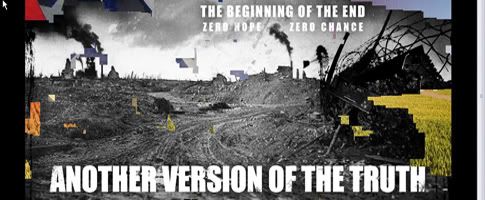
Subsequent pieces of the Year Zero narrative structure were discovered through USB drives left conspicuously at Nine Inch Nails performances. The community to which an ARG needs to solve the puzzles had already been built, and the contents of the flash drives were immediately subjugated to the tech-savvy puzzle solving of a hive-mind group. The songs contained within were placed under spectrographic analysis, and discovered to contain an image of another piece of the Year Zero narrative, The Presence, a massive hand stretching downward from the sky, as well as a telephone number that rang as the U.S. Bureau of Morality. These and other hidden pieces led to the discovery of the next Year Zero website, www.anotherversionofthetruth.com. The website contained a picture of a serene, rural setting of an idealized America, with the text, “A New Beginning! Zero Tolerance – Zero Fear – America is Born Again.” Dragging the mouse over the advertisement provided by the U.S. Bureau of Morality reveals a hidden image, one that would properly be described as an apocalyptic wasteland. The decaying remnants of an American setting are superimposed with the text, “The Beginning of the End. Zero Hope – Zero Chance.” Within this image, the first two words of, “This message brought to you by the U.S. Bureau of Morality” have been blacked out, to suggest that the destroyed society is in fact the result of this fictitious government agency (Another Version of the Truth).
Other websites and pieces of the puzzle were discovered using many similar tactics, and ultimately a timeline was built surrounding Year Zero and the major events that led to its eventual occurrence. The timeline, as created by users on www.ninwiki.com, reads as follows (Year Zero Timeline):
The NINWiki Year Zero Timeline
If nothing else, the large and growing scope of events contained within the timeline proves that the narrative structure within ARG’s is laden with depth, and the role of the participant in discovering these events is integral to providing a dystopia that is more in tune with a contemporary setting. Of particular importance is the event occurring on February 10, 2002, or in the adjusted timeline on February 10, 0000, this scientific experiment is the basis for which all of the underground banned information is said to have been sent back in time, and ultimately, the reason for which it is available to users presently. This tying of the story to our own possible future likens Year Zero to prophecy, in which the participants are able to discover future events, and approach their supposed occurrence with heightened regard for the narrative structure. This has always been possible with other mediums as well, but only with digital delivery has it been found to be a particularly potent driving force in appealing to the participant.
The summary of events known to presently occur in the Year Zero timeline shares not only the similarity of prophecy with other forms of media, but also many of the themes, motifs, and symbols within Year Zero are present in other supposed dystopian realities. Most obviously, the complacency induced society by the drug Parepin parallels not only the contemporary reliance of the populace on drugs like Prozac, but also the alcohol driven society in 1984, and very similarly the widespread use of Soma within Aldous Huxley’s Brave New World. This concept of dehumanizing the society is taken to its extreme in Year Zero however; as Parepin, through overly calming, is probably responsible for the removal of the sex drive altogether, and the subsequent lowering of the birth rate.
A lowered birth rate is also mirrored within the text The Handmaid’s Tale, as the result of widespread exposure to ecological disaster, whereas in Year Zero ecological disaster is replaced with bioterrorist attacks. Ultimately, both societies are left without many of their coastal cities. The Nation of Gilead in The Handmaid’s Tale shares many other concepts with Year Zero, specifically the removal of Constitutional Law and an elected President occurs in both texts, as well as that of a centralized religion. Each text also has a burgeoning resistance, as they are both early dystopian societies, unlike 1984 in which The Party is heavily established and resistance seems futile.
All of these shared concepts prove that dystopia within an ARG setting can deliver many of the same ideals as dystopia in popular literature, but it is through interactivity and communal participation that it attempts to surpass them. The nature of dystopia is to rely on contemporary society and then propose a potential future or alternate society that is a negative interpretation of modern fears. Literature and all media can succeed in this endeavor, but the internal narrative device contained in traditional media can only propose a possible, fictitious society. The reader is always left the opportunity to remove himself from the events, or suggest that his reality, his society, would be incapable of progressing on the path to a particular dystopia. ARG’s, on the other hand, suggest that the future society is the participant’s society, and they lay forth a consecutive series of events, almost always with relation to modern fears and anxieties, that seem probable and realistic. The participant is forced to accept the fear that his reality can lead to a dystopia, and he is presented with the course of events to maintain a vigilant watch for. Unfortunately, the strength and potency of the ARG dystopia only exists until the timeline has been proven false, and the events never occur. This too could be said of literature, as texts like 1984 lose some of their authenticity as the setting reveals itself to be inaccurate.
The most interesting aspect of the ARG is that in exciting the participant with a possible future reality, dystopian or not, the nature of belief, and volunteered belief, is raised as an issue. There may be similar events and modern fears, but most would still argue that a dystopian setting like Year Zero, set in the future, is largely and obviously fictional. Yet, the role of the player is skewed through their participation, and the player assumes a role of belief unknowingly, and defends the fictional world he has helped create. When gaps are present in the timeline, the hive-mind and community of players make the effort to fill and defend all arguments. In short, they help to create the setting just as much as they unravel it (McGonigal).
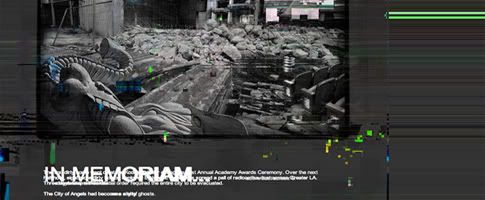
The Year Zero ARG benefits from this participatory creative notion held by its participants, but this particular piece of dystopian fiction also carries the weight of being an album of popular music. Just as many ARG’s rely specifically upon their role as viral marketing for films and games, the same must be said of Year Zero. The creation of a cohesive narrative structure between both the ARG and the Year Zero album makes use of trans-media storytelling, but each half of the structure is still in some way independent. In this situation, is Year Zero still valid as a piece of popular music? That is not to suggest that the Year Zero album doesn’t support the timeline, as it does. The lyrics and imagery all point towards the subsequent Year Zero event and specific items of the narrative structure are present. The songs each highlight and cryptically focus upon the plot devices within Year Zero. Starting with "Capital G," in which the leader of the supposed dystopian reality is blatantly intended to be President George Bush, other pieces of the puzzle, such as the military running the government in “Survivalism,” and the role of the church to watch the citizenry in "God Given,” are all nodded towards within the album (Sheffield). Take this particular instance from the song “The Warning,” concerning The Presence (Nine Inch Nails): “Some say it was a warning/Some say it was a sign/I was standing right there/When it came down from the sky/The way it spoke to us/We felt it from inside/Said it was up to us/Up to us to decide.”
Yet, while Year Zero the album may focus specifically on a dystopian world, it still must rely upon the foundation of popular music, which has become a largely disposable and forgettable machine. Is it safe to assume that without the addition of the ARG, that Year Zero would have failed in providing a narrative structure deep enough to propose a potential dystopia? The critical reception of the album has largely written off the potential concept of dystopia and instead suggested that the direction of the album served only as a catalyst to reinvigorate the quality of music Nine Inch Nails is able to deliver (Sheffield). This raises another question: While the ARG is open-ended and available in a communal setting, is it seemingly oppressive enough to alienate those that aren’t involved in the participation of the game? Ultimately, the critical reception of the album and the nature of popular music may be detracting to the Year Zero ARG, but the progress of the timeline and the participation of the players should continue nevertheless. The two elements of the larger project aren’t particularly independent, but one, the ARG in particular, should be able to carry the burden of the other if it fails in proposing a dystopian setting that will be popularly regarded.
It is the alternate reality game that is the most interesting aspect of the Year Zero narrative, and it is only fitting that while the album may stutter in its interpretation of dystopia, the strength of this particular piece of new media is enough to carry both into a cohesive and impressive position among many other dystopian settings. The ARG has proven through Year Zero to be a vivid and potent tool for dystopian narratives, and the definition and tenets of ARG’s are in line with propelling this plot further. That is not to suggest that Year Zero shatters the boundaries of all the dystopian literature and media that has come before it. Our fears are much the same as they have always been, and as such, dystopia must, in order to play upon them, recycle the concepts of 1984, The Handmaid’s Tale, and Brave New World. Where Year Zero propels from the traditional examples of dystopia is in providing the opportunity for the user to piece the narrative structure together, determine the connections with contemporary society, and ultimately, by creating a form of voluntary belief, possibly defend this fictional setting as a possible course for reality. Year Zero has given rise to a new evolution in dystopian setting, and it is one which grows through participation and is created with the possibility to change as quickly as our fears.
Works Cited
"Another Version of the Truth." Another Version of the Truth. 3 May 2007
Gundersen, Edna. Reznor nails big 'Zero' on the future." USA Today 19 Apr 2007: Life 01D.
Hon, Adrian. "The Rise of ARGs." Gamasutra. 09 May 2005.
CMP Game Group. 3 May 2007
"I Am Trying to Believe." I Am Trying To Believe. 3 May 2007
McGonigal, Jane. "A Real Little Game: The Performance of Belief in Pervasive Play."
Digital Games Research Association (DiGRA). Utrecht. Nov 2003.
Nine Inch Nails. “The Warning.” Year Zero. Nothing Records, 2007.
Sheffield, Rob. "Rolling Stone : Year Zero : Review." Rolling Stone. 17 Apr 2007.
Rolling Stone. 3 May 2007
Weisman, Jordan. "42's 5 principles of arg." CREATIVITY Volume 14. Issue 1. Jan 2006
03 May 2007
"Year Zero Timeline." ninwiki. 01 May 2007. MediaWiki. 3 May 2007
This research paper has been removed from its original format, and thus may contain certain formatting errors.
Future (Not So) Perfect: Exploring Themes of Dystopia in Orwell’s 1984 and Atwood’s The Handmaid’s Tale
The persistent appeal of dystopian literature has left a considerable mark on the course of much academic study. Novels such as 1984, The Handmaid’s Tale, Brave New World, and others remain constantly under the watchful eye of scholars and their students. Particularly, the nature of dystopian literature, which is to say, literature that shows the possible decline of societies not unlike our own, remains of interest because of the measure of similarities that can often be drawn to society as it now stands, and as it could possibly become. This proposes that much dystopian literature highlights current societal trends that tend to raise questions of the current course of economics, politics, or religious beliefs. Two dystopian texts in particular, George Orwell’s 1984 and Margaret Atwood’s The Handmaid’s Tale, deliver separate, but ultimately similar visions of the nature of possible dystopian states.
To consider a dystopian state, first clarifying the term itself is a necessity. The idea of dystopia is in short, the very opposite of utopia. Utopia, as defined in Thomas More’s text Utopia, is a small nation which seemingly lives in a perfectly ideal setting. A utopia, removed from the original literary source, has through time adopted the same notion. The term utopian is given to any civilization attempting, or currently undertaking in providing a society for its citizens that is better than the current conditions of other non-utopian states. The epistemological definition of utopia is “no place;” More could have been using the term itself to prove that the idea of perfection is not so easily attainable, although that has had little heed in altering the popular definition of utopia. To establish a utopia is to strive for perfection, and this is where More’s Utopia parallels the definition of the popular term utopia, despite the apparent failures the fictional society has been shown to succumb to. Just as dystopian literature is often based on the nature and course of the author’s contemporary society, More’s work is based in a time long past, and no longer proposes a place that the majority would proclaim to be ideal. Some would consider More’s Utopia to now constitute a dystopia, not only because of the vast difference in modern opinion from the time of More’s writing, but also is it not true to believe that attempting to create a utopia and failing is to potentially create a dystopia?
The natural opposite to utopia, dystopia is often described as an imaginary place in which people lead dehumanized and often fearful lives. (Merriam-Webster) Dystopias acknowledge the demise of individual differences as a way of keeping order in power and power in order. Dystopias are stories that contrast the failure of the main character with the unstoppable advance of society towards totalitarianism. The loss of the self is the character's final acknowledgement of, and ultimate contribution to, society's being definitively victorious. (Mihailescu) It is difficult to determine whether More has created a dystopia or a utopia, as our viewing of his text is now skewed by our own cultural opinions, but even then, the direction of most utopian/dystopian literature proves that “perfect” society is much closer to dehumanized and fearful society than one might think. For a utopia to become a dystopia is only through one small mistake or removal of freedom; it would be proper to suggest the two terms as opposite sides of the same coin, one flipping to the other with relative ease. The coin flips naturally to the dystopian side in the writing of 1984, which presents what might be the most potent dystopia of popular literature.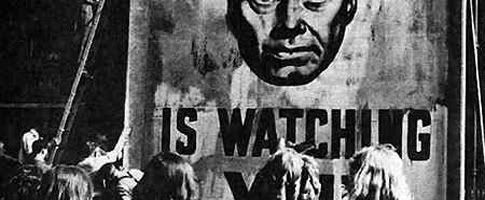
In writing 1984, George Orwell explores dystopia at its most hopeless and desperate vision. Winston Smith, living in Airstrip One, subjugated to a life that is in almost all possible forms, fearful and dehumanized. The laws and practices of Oceania, mother nation to Airstrip One and ultimately Winston Smith, portray a number of the characteristics (“International Reading Association”) that signify a society as particularly dystopian. Oceania is consistently under the influence of propaganda from numerous sources. Media, other society members, and most obviously the telescreens provide a ceaseless flow of misinformation for Oceania’s citizens. Individuality in any manner and even free thought are condemned to those living in Oceania. The society worships Big Brother, a figurehead that provides an emotional focus, and potentially doesn’t even exist. Those living in Oceania are thought to be under constant surveillance from the telescreens, microphones, and once again, even from other society members. The social structure in 1984 is also frozen, so as to allow as little movement as necessary. Each important aspect of Oceania’s civilization is built around maintaining a situation in which the populace is meant to partake in an obviously dehumanized and fearful existence.
Where 1984 depicts a society in which the whole of the populace is under the grip of a totalitarian state, within Atwood’s The Handmaid’s Tale, another possible dystopia is shown, and this one, while dehumanizing and potentially dangerous to all members, is a much more significant threat to the liberty of women. The Republic of Gilead, the governing party in The Handmaid’s Tale, follows many of the same tenants of what could be characteristically dystopian, but it also explores other outlets that Oceania doesn’t, just as Oceania explores some that The Republic of Gilead neglects. The Republic of Gilead is modeled after a religious precedent, particularly The Christian Bible, a text that many in contemporary American society proclaim highlights what could potentially create a perfect society. This questionable source material for creating an ideal state allows those in power to propose a society that is actually an illusion of perfection, particularly an illusion in which men are superior to women. Men have (power over) "the word", women do not; "the word" is singular, monolithic, and biblical because it originated by God, the father. (Cavalcanti) Those living in Gilead are expected to conform to the standards set for their particular caste, whether they are Wives, Econowives, Handmaids, or Marthas. Citizens are also under the impression that they are consistently under surveillance by the Eyes. Naturally, this all makes for a society that is potentially as dehumanizing as the society in 1984, or any other similar oppressive state.
While these are both but small descriptions of the particular aspects that emphasize what makes each of these societies particularly dystopian, they obviously share between the two, a number of obvious similarities. Both societies focus on maintaining an apparent constant surveillance on their members, or at least imposing the thought upon their citizens that they could possibly be under surveillance. Also, the removal of freedoms is a necessary aspect to both dystopian states, and the members are restricted from possessing certain materials that can help propose individuality, freedom, or the knowledge of other or past societies. These similarities constitute what could possibly be the more weighted aspects necessary to create a dystopian state, at least in these two particular societies. To suggest that each author chose these among all possible outcomes as coincidence is to propose that these similarities weigh the same as other, less important aspects of each society. The notion of dehumanization, limited freedom, and constant surveillance are present in each text because these concepts maintained to be a fearful aspect of society not only during the writing of 1984 in 1948, but they also proved to be significant until the writing of The Handmaid’s Tale in 1985. The nature of dystopian, and even utopian, literature is undeniably shaped around society during the time of any text’s creation, and this fact, proves that while a particular setting, or other elements of a dystopian text may change, the reoccurring elements are the most important in defining society as it currently stands, and the possible fears that arise from the course and direction it is taking.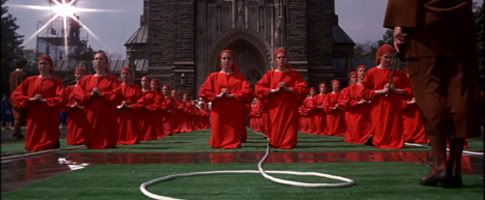
That is not to proclaim that the differences between the two texts aren’t equally valid in determining the fears and status of society at the time of a texts creation. The feministic view of Atwood’s The Handmaids Tale provides a very effective inspection of society at the particular time in which she was writing. Atwood explains herself, “The majority of dystopias - Orwell's included - have been written by men, and the point of view has been male. When women have appeared in them, they have been either sexless automatons or rebels who have defied the sex rules of the regime. They have acted as the temptresses of the male protagonists, however welcome this temptation may be to the men themselves.” (Atwood) However, this particular viewpoint of a feminist dystopia can only show the topic as it is understood within society at the time of her writing, not how important the issue has maintained to be, by consistently proving a factor in dystopian states through changes in time and society. The Handmaid’s Tale provides an excellent example of how relevant this is towards a temporary setting in the novel coming to no particular conclusion in the story of Offred. This irresolution reflects the position of mid-1980s feminism. In articulating the potential danger of certain directions in which the movement had been heading, the novel can only advise its readers to err on the side of caution, and defend liberty before ideology. (Tolan)
Some of the aspects of 1984 that aren’t shared in The Handmaid’s Tale are just as rooted in the post-WWII era in which Orwell was writing. The widespread fear of fascism and totalitarianism in this era is particularly responsible for the structure of the Party, and the realistic parallels to the failed communism in The Soviet Union between characters like Big Brother and Goldstein, and their possible counterparts in Stalin and Trotsky originate directly from Orwell’s own belief in socialism. Each of these aspects are integral towards the composition of a dystopian state in 1984 and The Handmaid’s Tale, but the rooted nature of these differences to their particular time periods could propose that these elements are secondary in nature, while the primary elements are those that tend to be more pervasive through all dystopian literature, and reoccur more commonly throughout the texts.
Identifying the nature of dystopia through the particular elements that most often repeat in literature allows for not only an academic analysis of each text, but also provides the opportunity to discern what core dystopian fundamentals are still being instilled through our society, and even through our own limited viewpoints. The nature of dystopia is to be dehumanizing and fearful, but the study of dystopia can provide answers to where fear and dehumanization truthfully originates. Orwell’s 1984 and Atwood’s The Handmaid’s Tale explore two dystopian societies, separated by nearly half a century in societal change, and yet each novel focuses on similar aspects of dystopia that have carried through those time periods in either society, or in the very core values of ourselves. For these fundamentals of dystopia to remain fearful allows us to, in some respect, define ourselves by them, while the differentiating aspects of each text can show society as it existed, or currently exists, only in discovering the pattern of how we view dystopia, can society attempt to view and shape where it will ultimately choose to travel.
Works Cited
"Definition of dystopia from the Merriam-Webster Online Dictionary."
Merriam-Webster. 2006. 1 Mar 2007
http://www.m-w.com/cgi-bin/dictionary?book=Dictionary&va=dystopia.
Mihailescu, Calin Andrei. "Mind the Gap: Dystopia As Fiction."
Style 25. 21991 1 Mar 2007
http://web.ebscohost.com/ehost/detail?vid=1&hid=122&sid=...
cace465a-734e-42a3-ba33-ec3ce866ea03%40sessionmgr102.
"Dystopias: Definition and Characteristics." International Reading Association. 2006.
International Reading Association. 1 Mar 2007
http://www.readwritethink.org/lesson_images/lesson926/DefinitionCharacteristics.pdf.
Cavalcanti, Ildney. "Utopias of/f Language in Contemporary Feminist Literary Dystopias." Utopian Studies 11. 22000 1 Mar 2007
http://web.ebscohost.com/ehost/detail?vid=1&hid=101&sid=...
a781beb2-fbb7-496e-94be-c227dbc06d4c%40sessionmgr108#AN0004215697-9.
Atwood, Margaret. "Orwell and me." Guardian Unlimited. 2006.
Guardian News and Media Limited. 1 Mar 2007
http://books.guardian.co.uk/print/0,,4691839-99930,00.html.
Tolan, Fiona. "Feminist Utopias and Questions of Liberty." Women: A Cultural Review
16. 12005 31. 1 Mar 2007
http://web.ebscohost.com/ehost/pdf?vid=2&hid=122&sid=4b25353f...
-9d09-4ec7-825a-21a532a10f17%40sessionmgr103>.
Note: This paper has been copied from it's original format, therefore certain italic, bold, and other pre-formatted styles may not be included. Links may, or may not work as copied, please contact me for more detailed source information.
Considering The Lathe of Heaven to be dystopian feels initially to be more of a stretch than saying the same of other works like 1984. This probably lies in the fact that the plot of 1984 centers upon a focus of realism, where The Lathe of Heaven explores science fiction. Just as in V for Vendetta, the entry of story elements like superhuman abilities removes much of the fear that the text would otherwise present. That’s not to suggest that the idea of someone who is capable of changing the world through dreams isn’t fearful, as this is shown very specifically in the case of Dr. Haber’s nightmare reality, but the notion itself is so outside our own society that it doesn’t lend itself particularly well to rationalizing dystopia in comparison to our cultural reality.
Texts like 1984 and The Iron Heel allow us the opportunity to view the progression of our own society in relation to those proposed within the works, but the inclusion of particularly outlandish things like aliens that appear to look like turtles and a world of gray people remove our own culture from the work, and act as a buffer for the dystopian world Leguin suggests. The relevancy is there, of course, just shadowed under laughs and feelings of distance from the events that occur.
Gray people as a solution to racism is an obviously important plea about the problem itself, just as a plague that solves the overcrowding of the world is a terrible solution to the issue, but relying upon the irrationality of dreams to solve these issues leaves the novel essentially without someone to blame. Haber is the culprit behind the manipulation of George Orr’s dreams, but as the book continually reminds the reader, his intentions are noble. Obviously, the same could be said for most totalitarian governments and despots who are seeking to improve the world, so in some way Haber assumes the role of imposing fear just as the totalitarian government in 1984, or the oligarchy in The Iron Heel. However, does the reader ever casually make that connection, or does Haber never feel as particularly threatening as The Party?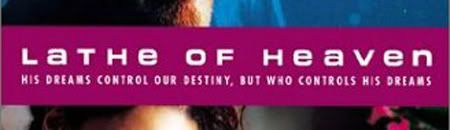
If he doesn’t, then why not? Perhaps the reader is reminded one too many times of how noble he is, or maybe the fact that Haber, while continually growing in power and significance in the multiple realities Orr creates, always remains tucked away in his office and removed from the world at large. He doesn’t become the President, or a living God in the eyes of the people, instead he remains unknown, simply shaping the course of reality. In actuality, once his position is closely examined, which is more fearful? The open dictatorship and propaganda of 1984, or the silent molding of society to the ideals of Dr. Haber?
Haber’s fear might have been more recognized if he used a more potent tool to shape reality than the dreams of George Orr. The single most deterring factor to comparing The Lathe of Heaven to a contemporary culture is that the dystopian element of society isn’t imposed by a realistic means. Dreams are irrational, and thus they are largely written off as a fearful means of proposing a future reality. They may only be the tool to which Haber applies his trade, but capitalism was the tool to the oligarchy, religion to Gilead, and technology to The Sprawl; these things resonate with us, and the dystopian worldviews they could bring about seem fearful because of it. They are culturally significant issues, whereas dreams, and shaping reality by them, are more a dream of their own.
Alan Moore explores dystopia within V for Vendetta in a very similar fashion as George Orwell in 1984. Both works establish a totalitarian regime in Great Britain, and both focus on a “future” world that, despite being history as of now, isn’t necessarily futuristic. The setting of both works is grounded in reality for the most part, and as such, inspires readers to believe that the resulting dystopias are more possible, and ultimately, more fearful.
It’s strange to assume that otherworldly and seemingly impossible things are less fearful than the familiar. However, through some byproduct of human reality, it is almost always the case that skewing the familiar is more unnerving than the fantastic. Not to leap away from the literature at hand, but this is very prevalent in the production of digitally animated films. For this reason, Disney, Pixar, and Dreamworks consecutively choose to employ a stylized look to all their creations, as opposed to something like The Polar Express, in which we notice that closeness to reality, and are immediately repelled by it. Animators and those working in robotics have noticed this phenomenon, and labeled it the Uncanny Valley. Literature isn’t foreign to the valley, and we see that in work like V for Vendetta and 1984. In short, the closer these works seem to reality, the more they frighten us, while the more fantastic elements they propose, the less threatening they seem.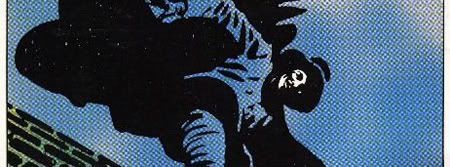
It’s particularly noticeable in the way in which we derive fear from V for Vendetta. So much of the resultant fear from reading the novel is directed at the totalitarian regime and fascism, the more realistic components of the work, that readers never identify V as an anti-hero, nor do they ever draw fear from the power and threat he poses to the human race. In his dialogue over the television broadcast V clearly proves the point that he defines himself as beyond human. He likens the human race to factory workers while he is the overseer, the management. This notion of an evolved being, even one that was created by human experimentation, is too fantastic to seem fearful, and as such, is written off by most readers.
It is in Alan Moore’s other most prominent work, The Watchmen, that he explores this fear alone. In a fictional world in which beings can have superpowers, humans are already facing an entirely different sort of dystopia than that of a totalitarian regime. This sort of dystopia is explored almost solely in the world of comic books and not literature, although The Lathe of Heaven, as far as I have inferred, seems to raise the question as well.
That isn’t to suggest that the totalitarian regime within V for Vendetta isn’t important. It just clearly isn’t the focus of the work. Moore never crafts a vastly threatening nation like the one present in 1984. This could have been intentionally done by providing the details of a fringe criminal society, a populace almost ready to be lead free by V, or a leader that is, while still somewhat threatening, a pawn to a machine, or it could simply be the result of poor writing. Moore may have wanted to suggest this government was vastly threatening, but the novels focus on V makes it seem otherwise. This is V’s vendetta. Is it against those who have imprisoned and experimented upon him, or is it against the entire human race? Through his death has he achieved victory by freeing the people, or by crushing his enemies? V’s actions seem noble in the face of those who are willing to topple a fascist regime, as we should all be, but is it acceptable to have a human society, of any kind, fallen under the throes of a being that views himself as better than human?
Within the last third of The Iron Heel, the novel finally breaks free from a seemingly realistic historical text and moves toward the dystopian domain. While the setup to this climax may have some dystopian elements, it is when the early 1900s society crumbles, and the oligarchy abandons what we would consider fair governmental practices, if we have the right to even suggest those, that a dystopia is fully realized. Prior to this we see what interestingly could be taken for history instead of the proposed future that London was writing about. Whether this comes four our lack of knowledge about the actual historical events in this time period, or from how culturally relevant these ideas and events seem to be, is something that could be debated. Regardless, what London suggested as the future we partially interpret as what could have been our past, so where does that leave us in comparison to the ultimate destination of society that London deemed the Brotherhood of Men?
Surely we haven’t yet reached a society as ideal as the one London suggested could come to power in 2200, but are we closer than he might have imagined, or is the oligarchy still in control? It’s hard to not suggest that the oligarchy doesn’t have some sort of control over society, even now. The truth that 1% of the world population controls 90% of the wealth is a genuinely potent example of how strongly capitalism has favored the select few, and it wouldn’t be outlandish to think that they’ve even gone farther than London imagined, by not attempting to impose a strict caste system and instead indoctrinating the belief that we should strive for that wealth, and that it is actually available to us, when realistically it isn’t. The class ladder is still used as a model to teach students that there is the low, middle, and upper classes, when it is evident to most that regardless of the naming and subdividing of the lower class, there is little more than the lower class, and the upper class – the oligarchy, of which migrating upwards to is impossible. This hidden truth that not everything is available to everyone, despite what they’ve been told time and time again, must be the most controlling aspect of our modern oligarchy. 
The Socialist revolution that The Iron Heel focused on never does occur, and even now it doesn’t seem particularly possible. If anything, a defeat of the modern oligarchy will come as most other things have seemed to occur, as a gradual waning towards something better. This is akin to what Ernest proposes as a kind of social evolution. Society moves forward by growing in the direction of something more habitable for all. The amount of our beliefs and opinions that are now in league with socialism, whether we know it or not, are proof of this. Unlike much of Ernest’s philosophy however, it seems rash to believe we’re incapable of moving backwards. Much can happen in a society to reduce it to something it had thought it surpassed. Human nature itself shows this flaw to be something we contain. In examples like the Abu Ghraib prison incident, and even more clearly in the Stanford prison experiment conducted by Dr. Philip Zimbardo, people have shown that all of societies imposed progress can be quickly rewritten.
Even with our slow crawl towards the wonder cities of The Iron Heel, that destination seems much farther off than the relatively close year of 2200. Much can happen in 200 years, but the amount of conflict still in the world is a depressing tie to modern times. The oligarchy, albeit a slightly different beast than what London proposed, is still in control, and the slow process of moving the course of society towards The Brotherhood of Men is currently drudging along.
The truly dangerous thought is that what if all of our progress toward a better and more civilized society isn’t actually the result of wearing down the oligarchy, but instead it is the freedoms that the oligarchy merely allows us to enjoy, in order for them to maintain their role as our prison wardens. This sort of deliberation and knowledge is reminiscent of how brilliantly The Iron Heel’s oligarchy squelched the first rebellion in Chicago, and it is a scary thought to consider how that could translate to today. If nothing else, we at least have the luxury of knowing that society hasn’t yet reverted to the very dystopian “future” that The Iron Heel proposed. We aren’t the same sort of slaves they had become, and luckily, we never did find it necessary to go as far as reinstating crucifixion. Thank goodness.
Distancing itself from other texts like 1984 or The Handmaid’s Tale, Neuromancer is in comparison, the least dystopic view of the future, or at least, it seems to be. Just as a dystopia ruled by drug abuse appeals to the drug addict, a dystopia centered on laziness appeals to the lazy, and a dystopia ruled by technology ultimately appeals to those with an interest in technology. In that sense, Neuromancer, and cyberpunk in general, reaches out to the readers of today, and the text dangles in front of the reader a vision of the future that may be fueled by violence and dehumanization, but the allure of the technology still persists. That is where Neuromancer strikes a strong chord in modern society, because the allure of technology is growing considerably more prevalent each generation. Gibson seems to ask the question, “What would you give up to have what I’m offering you in this future?”
Obviously, the question isn’t so easily answered for us, but for Case and Molly, the choice has already been decided. It’s interesting that while they were curious about the nature of their assignment, they never chose to abandon it, even after they realized the ultimate goal of Wintermute. Case never asks what the outcome of freeing an artificial intelligence could be. Case could only be Case, and do as was expected of him. The same could be said for Molly. The two are almost symbols for the direction all of society took in Gibson’s future. One side of life embracing the low, gritty violence of the streets, and the other withdrawing into cyberspace, to explore a different world, one without the nuisance of, as Case would say, the flesh. It could be suggested that the entire novel is centered on exploring two characters, each an opposite side of the “fight or flight” mechanism.
Apart from technology itself, many of the dystopian elements of Neuromancer are only alluded to. This is a world ran by corporations, but Gibson never fleshes out how terrible this idea could be; he saved that vision for the story of Molly’s past lover Johnny. Johnny Mnemonic is that character, and in the film of the same name, the true horror of a society ruled by corporations is the direct focus. That is, it would be the focus, if the film was actually good. It isn’t. This is also a world in which technology has made for terrorism to be an even simpler task than it now is, and even this, although at the time of writing Gibson probably wasn’t nearly as focused on the act of terrorism as we are now, is only briefly mentioned in the context of the larger events occurring between Case, Molly, Armitage, and Wintermute.
The novel itself never explains clearly what the outcome of Wintermute’s merging with Neuromancer is. We only know that Wintermute was destined to seek Neuromancer, and Neuromancer, not needing any personality because of its structure, was destined to avoid this fusion. Although, destined probably isn’t correct term, the two intelligences were programmed, not destined, to follow their respective paths. What is the result of having a free, sentient artificial intelligence roaming cyberspace? Gibson never answers the question, and he never suggests that there is anything particularly threatening resulting from it. Even now, considering society’s progress towards Gibson’s future, this issue is the most difficult and curious one presented throughout the whole of the text. Are we prepared to live in a society in which a machine can exist in a more powerful position than any human being? A machine that is aware it is a machine, that still has no true emotions and no concept of feeling outside the program it was created to follow. Perhaps Nueromancer is quite the dystopian novel after all.
While the focus of The Handmaid’s Tale is primarily on the subjugation of women, just as much attention could have been placed on how fearful the idea of reverting to early Christian ideals is in all cases. The society that brought forth the Republic of Gilead seems to have progressed slightly more liberally than our own, or perhaps Atwood is only focusing on the most negative aspects of our own society, but for a world even similar to our own to allow itself to embrace nothing more than tradition and religious precedent; that is a frightening premise.
Interestingly enough, Atwood proves through the actions of nearly every character in the book that although The Republic of Gilead has proven itself a strong enough force to capture a large portion of America, it has failed in capturing the hearts and minds of its people, and is most probably doomed because of this. The fact that the novel is taking place in early Giladean history could prove that the nation still has a chance to establish itself further, but in reality, the characters’ passion for the world they left behind is too persistent and alluring for them. The Commander himself never mentions as he tours Offred through Jezebel’s that this “necessary evil” is something to be left behind over time. He still yearns for socialization with women and the many other fragments of pre-Giladean society that were lost. Serena Joy is just as troubled with this new society, although her own religious preaching could have been a propellant of Gilead; ultimately, she is left without that outlet in the new society, and is something of an empty shell.
A realistic analogy for the state of The Republic of Gilead and its people would ask: If you were to throw a stone down a chasm with a rope attached, you could always pull it back up, but if the stone fell too far, would you still be able to, or is the stone too heavy, and has it traveled too far? Could a society similar to our own actually revert to tradition and early Christian ideals or would attempting to do so prove that they’ve come too far (through good or bad progress) to ever really allow that of themselves?
The appendix seems to justify that Gilead does indeed fall, but to what extent, and at what cost? Apart from naming The Republic of Texas, the world is left open for interpretation. Atwood could have been leaving something optimistic for the reader, going against so many other dystopian novels, but at the same time she chooses carefully to include some chauvinistic attitude in the speaker, and never truly focuses on the atrocity of Gilead, just the occasional fact. Is post-Giladean society dehumanized, or is it back to what it once was? Which is better, and which is worse?
If society has returned to the state it was before Gilead, have all the negative aspects of society returned as well? It’s interesting to propose that while the feminist movement was undoubtedly positive, demanding so much freedom could have been the lone catalyst that propelled Gilead into being. The feminist movement, in some small way, is responsible for much of the open sexuality and lack of “traditional values” that inspired the men in The Handmaid’s Tale to rebel. Women like Serena Joy, scared of the waning morals in modern society, were content with letting, and even helping, the change to take place. Of course, our society doesn’t parallel this exactly, and while we have obvious similarities, it would be difficult work to prove that the feminist movement did even close to as much harm as it did good.
At some point in reading Utopia, it becomes evident that Thomas More isn’t necessarily describing the ideal society, the definition for which we have given utopia, but his own version of that society. That’s not to say anyone who attempted the task would be able to deliver anything more than that, but More succeeds in coming closer than those with less wit, and less idealism otherwise might. His description of Utopia, and the Utopians, proves that he has taken the task of building a perfect society very seriously, and perhaps at the time of his writing, most could have agreed that the world described by Raphael Hytholoday is a near-perfect vision of a commonwealth.
Unfortunately, with the knowledge that hindsight allows, it becomes mostly evident that More’s ideal society, while noble, is still rooted particularly in the customs and times from which the text originates. Could the society of Utopia still prosper in a modern and technological world? More’s definition of utopia might, if reevaluated today, mention that there is no need for the technology that we now have; and that it only stands in our way from reaching the state of a perfect society. However, that stands in direct opposition to the course that More gave the Utopians by embracing the idea of the printing press so openly. More opened the door for the Utopians to accept technology, and while our technology today might often contribute to a less than noble society, it has become something that in our own, modern vision of a utopia, we couldn’t live without.
Interestingly enough, while much of our society is in direct opposition with the Utopians, that doesn’t necessarily mean we aren’t similar. At the time of writing, More predicted many things that actually came to pass years from his original writing, such as women being able to marry at the age of 18, or the idea that Utopia was a nation that allowed it’s citizens to embrace any religion they chose. These ideals, while More may have borrowed what he felt were the best ones from ancient civilizations, often weren’t popular until hundreds of years later.
The age of More’s Utopia also shows in the occasional brutalities and direct courses of action for many crimes and punishments. For the simplest transgressions citizens are reduced to prisoners, and the consistent notion that acting against the society will cause them to be looked down upon, or disrespected, makes for a society that is obviously oppressive to those harboring any ideas of change. Utopia even makes use of the death penalty for numerous offenses, some less deserving than what we allow today. Could we look at a society in modern times and view that as ideal?
Religion in More’s work is actually one of the more forward-thinking aspects in Utopia, but there is one section in the text that seemed unnecessary. My original belief that Christianity wouldn’t have been accepted in Utopia was obviously incorrect, but in review, it was my own view of Christianity that was shaping my opinion. Where I see Christianity as believing Jesus is the son of God, the Utopians have accepted what seemed to be the view that Jesus and God are one in the same, which is a fairly popular perception. This isn’t so far outside the idea that Utopians believe men are all born equal, but it did still feel forced into the reading. More’s own religious views might have been overshadowing the impartiality he gave to the character Hytholoday. Even later in the writing More’s description of the most holy priests in Utopia also seems awkward in relation to the other descriptions of Utopian society. Why, when princes and all other men were viewed as equals, were these priests so unique in being revered and respected?
Ultimately, More might have failed in creating a society that is perfect and would forever continue to be. Whether that is based on his own faults in opinion, the limited vision he could have coming from his time, or the basic belief that we as people can’t be jammed into an “ideal” society; is difficult to say. It is obvious though; that the fictionalized society of Utopia is a vision that is easily one of the most noble, and complex works ever created with the hope of making a nation a better place for all of its citizens.
Within 1984 George Orwell delivers what is essentially the most popular vision of dystopia ever written. The texts popularity is most commonly based on how Orwellian our society has become, or how 1984 has become more prophecy than fiction. Unfortunately, while the similarities behind Oceania and modern society are understandable, they aren’t the reason this novel should have such staying power. The true impact in 1984 is how completely and brilliantly Orwell envisioned dystopia.
Oceania is a society without flaws, without hope, and without end. The character Winston, until his ultimate acceptance of the party, portrays us. Humanity, for the most part, as it now exists. He is able to think freely, to rationalize, and to discover the world for himself. He may have to fight a battle against some very strong opposing forces to do so, but it is still an opportunity available to him. 1984 is the story of the final destruction of man as we are now, through Winston. Even O’Brien makes note to tell Winston he is, “the last man.” Men are extinguished in 1984, and only party members exist from the time after their extinction.
It could be realistic to ask, “What about the proles?” Winston asked himself the same question. Are they not still proof of humanities persistence? That was answered within the novel as well, “The proles are animals.” Through this answer each mention of the proles and their imaginary revolution is quenched as quickly as it is brought forward, and it is disturbingly correct. The proles are animals, even in an almost literal sense. They exist as the meat of the party, the cannon-fodder for wars and territory, and they could most properly be considered sheep. Their intellect has been forced downward by the party, the most intellectual eradicated, and their only real outlets include simple roles and the lottery. If there is a prophetic vision in 1984 to modern society, this is the most potent. Are we not often envisioned as sheep as well? We could be as much slaves to the forces in our lives as proles. Luckily, the integrity and intelligence of our society, while it is always in question (as it should be), is still a far cry from 1984, and I think most would suffer a revolution before we accepted a similar situation.
If there is any true threat proposed to us in 1984, it is the idea presented in altering reality. Although not quite as literally as when O’Brien claims he could float from the floor, as my ethnocentrism refuses me the ability to believe my mind could accept that, the idea of changing reality through the manipulation of history, language, and attitude is the strongest and most fearful aspect of the party. Oceania succeeded in removing thoughts from the brains of party members, and they did it not only through unspoken laws and the fear tactics of a repressive state apparatus, but also through what could be described as the destruction of academics. Removing thoughts is as easy as removing the knowledge that is their source. No one in Oceania is learned in anything other than their field of work, and even then they are barely adequate. Why should a society have 10 intellectual workers, when 100 average workers are capable of the same effort, and with less risk? Limiting the knowledge of an entire population is the most threatening aspect of 1984. The idea that this could be happening now without our knowledge is nothing short of scary, and the truth that no revolution could combat this or none would ever even be able to occur is even terrifying.
I suppose that in that context many could be correct in assuming 1984’s staying power is in how Orwellian our society has become. I can’t see it from that perspective, partly because I can’t take the bad without the good. Our society has adopted some patterns undeniably similar to the party, but we still retain the ability to question and fight against those policies. We are, unlike Wilson, still men, with at least some sense of freedom. Even if it is only the freedom to debate how much freedom we have, we still possess it. I could never accept Orwell’s book as prophecy or even an envisioning of what our society is headed towards, but I’d rather view it as a guide. Just as More’s Utopia was a guidebook in achieving what could be a perfect state, Orwell’s 1984 is also a guide. It is the guide to how totalitarian society could become if we don’t maintain a watchful eye on those in power, the knowledge of the populace, and the truth that could be avoiding us.
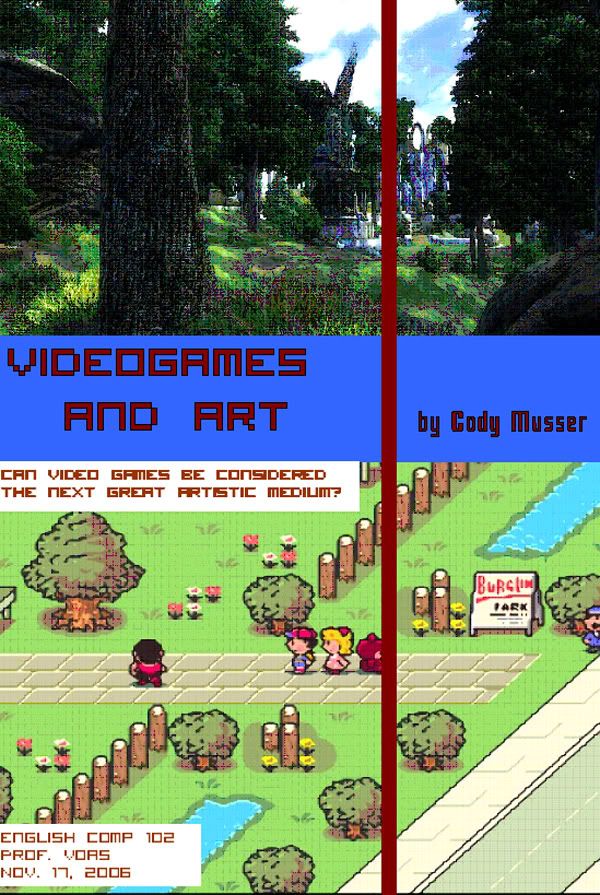
The advent of any new form of media carries with it the introduction of debate. Can film ever carry a story as well as literature? Will a soundtrack ever incite the same emotions as a symphony? As time passes, the debate settles, and the lines are drawn for that particular medium. Videogames, the relatively young form of media that they are, are still wavering amidst the debate that previously surrounded other forms of entertainment. In particular, videogames face the same difficult views that accompanied theater, and ultimately film, during their respective times of origin. While film and theater have rooted themselves within our culture, and have taken favor by those who would deem each medium a form of art, videogames still face a strong opposition. Those who feel videogames are either unworthy or unfit to be critiqued and appreciated as an art form weigh heavily on the issue, and their opinions sway an obvious majority to their cause. Unfortunately for those hoping to halt the artistic appreciation of videogames, the undeniable presence of art in all facets of videogames, be it creation, the end product, or the experience of play, proves that videogames are a new and emerging art form.
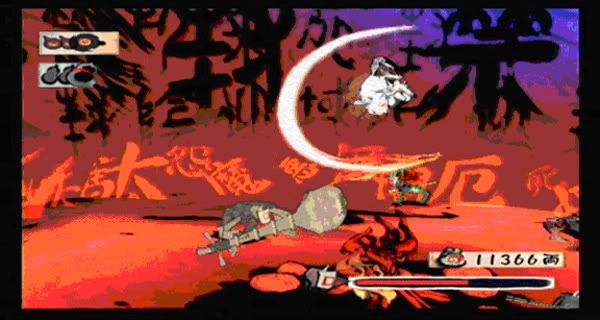
The traditional brushstroke style of Capcom’s Okami surely deserves praise as an amazing piece of artwork.
The first appearance of art within a videogame is noted before the game is even a playable product. The creation of a videogame requires the presence of an artist from as early as the concept stage. Artists contribute to key moments in the creation of a game, whether as concept artists, character artists, animators, or level designers. (McCarthy 100) Artists also deliver to more than the visual aspect of a game, as composers often deliver the sound effects and music, and occasionally a game that offers a heavily scripted narrative or numerous dialogue situations will find it requiring input from authors and screenwriters. (McCarthy 110, 120) Videogames and film share an uncanny bond in these early development stages, and most likely for that reason, some of the world’s most famous film makers are venturing into video game creation. Steven Spielberg, director of Schindler’s List and Jaws, and Peter Jackson, director of King Kong and The Lord of the Rings are two of films most beloved directors, and they’ve both entered the realm of video game creation. (Tornquist)
The unfortunate truth is that while artists may help in the creation of videogames, that doesn’t necessarily determine that games can stand their ground as an art form. Artists may also help create the layouts for newspapers, and contribute to numerous other affairs not necessarily respected as art, but that has had little impact on proving that a newspaper is a piece of art. Luckily, while a newspaper might not be deemed art-worthy by appearance, that doesn’t mean the writing contained within isn’t art. The same can be said for videogames. The inclusion of artists doesn’t necessarily demand that a game is art, but the product and content they deliver, is luckily another consideration.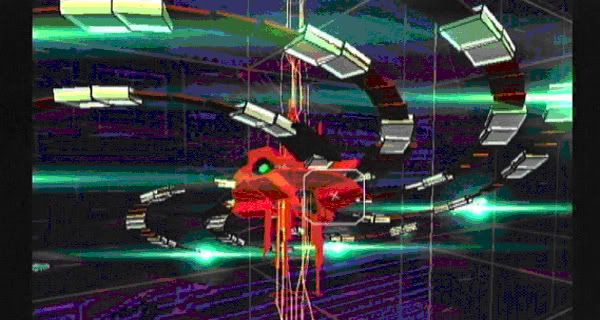
The acid-trip like visuals of Rez pulse and react to the players input and the accompanying soundtrack.
The final product delivered in a videogame is literally boasting of its artwork immediately. As soon as a game is placed on the shelf, the artwork on the case captures the eye of the consumer, and ultimately the visuals of the game itself are built around delivering the most impressive product as possible. Whether a game is stylized, realistic, or abstract, videogames represent art, and they represent a new, interactive form of art. Whether or not video games succeed in enrapturing the player isn’t necessarily important, as other forms of art can also fail in enticing particular audiences. The most important effort is that they make the attempt, and that is more than enough. As Dr. Henry Jenkins, Director of MIT’s Comparative Media Studies Department, states in the preface to Nic Kelman’s Game Art:
“Video and computer games, as we currently understand them, constitute art. I emphasize the phrase, “as we currently understand them,” because there are many more critics who have been willing to see games as a potential art from, seeing there the building blocks of something great and wonderful which we will see some day. For them, games can become art when they assume serious purposes, when they become meaningful activities, when our best artists build games, when we perfect the artificial intelligence, in short, when hell freezes over.”
Kelman argues that videogames are art in all their forms, simple or complex, as game designers are gifted craftsmen who construct compelling and visually fascinating worlds deploying skills which we would see as artful if applied in any other context, and that video games are also constructing meaningful experiences which tap deep chords within our culture, in part because they are carrying on timeless functions previously associated with myths and legends. (Kelman 8-9)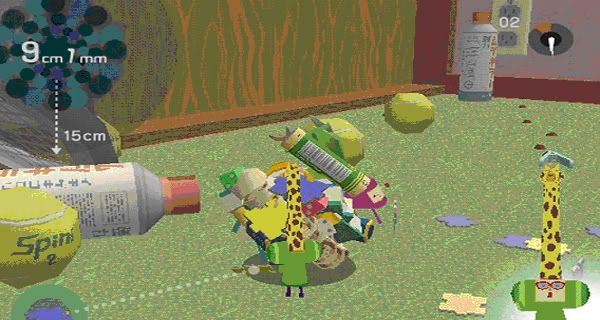
The abstract premise of Katamari Damacy: The Prince of all Cosmos endeavors to literally roll up the world.
The particular praise that Kelman attributes to videogame worlds is noteworthy, yet there is an attribute of videogames that hinders their appreciation as art. That attribute is interactivity. Interactive art is a relatively newly birthed creation, and as such, it doesn’t necessarily help that video games are rarely enjoyed by anyone more than the player. Those not experiencing a videogame through gameplay are restricted in a similar fashion as those watching a film, compared to those determining the events and situations present in the game world. This notion of videogames is what allows many critics to state that they can never be a true art form.
Those same critics should reconsider, as they are forgetting the most important aspect of interactivity. Interactivity marks a crucial distinction between decidedly non-interactive mass art forms such as film, novels, and recorded music and new interactive mass art forms. (Smuts) Interactivity is actually delivering an experience, one that could possibly be more artistic in nature than any medium that has come before us to date. The experience of traversing a game world leaves a respect of all the various outlets of artwork within a game. Players are subconsciously forced to take notice of the choices made by artists at the original concept stage, those being shown in gameplay and the overall style of the game world. Then, the art contained within the overall product of the game, thus leaving them noticing the visuals, details, and story. Ultimately, the binding of these various layers of art allows videogames to define themselves as not only an art form, but through delivering a lasting, interactive experience, they could become the most important art form of the future.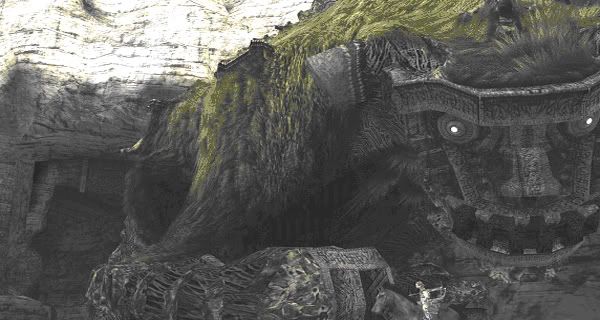
In Shadow of the Colossus, players are forced to emotionally slay mythic beasts that have caused no harm.
Where videogames lead art is knowledge that no one is privy to as of yet, but it is interesting to see that they first face the same questions that have surrounded other art forms for all of history. The philosophy of art is laden with issues surrounding definition, and videogames are obviously no different. The debate surrounding games has led to the redefining of terms such as ‘interactivity’, ‘videogames’, and even ‘game’ itself. (Smuts) The weighty discussion on these terms is proving that the critics unhappy with the notion of respecting videogames as art are already facing difficulty in voicing their opinions with concrete proof.
The gaps within the academic definitions of terms like “videogame” have left scholars and philosophers with much debate still necessary to classify games as an art form, and even what particular form of art games should be considered. Are they more closely related to film, or are they similar to performance arts, such as dance? Perhaps they are more akin to competitive sports and games like diving and chess? (Smuts) Videogame creators seem content to leave this debate to those willing to participate, and some have gone as far as to deem that they are striving not for art in their creations, but for enjoyment. Hideo Kojima, creator of the Metal Gear Solid series of games, said, "Art is something that radiates the artist, the person who creates that piece of art. If 100 people walk by and a single person is captivated by whatever that piece radiates, it's art. But videogames aren't trying to capture one person. A videogame should make sure that all 100 people that play that game should enjoy the service provided by that videogame. It's something of a service. It's not art. But I guess the way of providing service with that videogame is an artistic style, a form of art." (Graft) This definition deems that games should be considered a product first, before they are deemed an art form. While Kojima may feel this way, the actual truth lies in the various examples games set forth.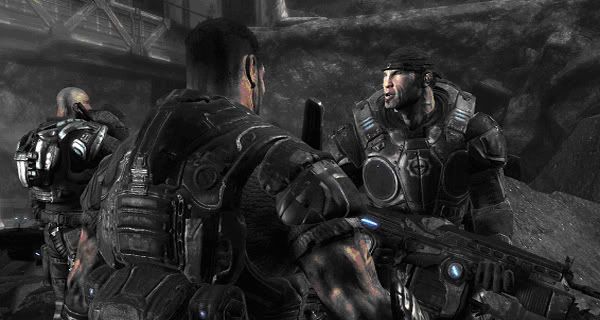
Realism in games is brought to the forefront of importance in Epic’s grizzly space shooter Gears of War.
The artistic endeavors of games have spawned numerous examples of which traditional art has been called upon to continue an idea, story, or visual that was originally created within a videogame. If games aren’t worthy to be deemed art, how could they possibly carry such ramifications within the artistic world? Traditional art galleries have given forth their space to “I AM 8 BIT”, an annual art show dedicated to video games. (I AM 8 BIT) Film has been literally overrun by projects based on the worlds created within videogames, including movies based on the games Silent Hill, Resident Evil, Castlevania, and Halo, the game whose sequel Halo 2, sold $125 million worth of copies within its first 24 hours available, thus making it the single fastest selling piece of entertainment the world has ever seen. (Smith) Literature, comics, and music have also all seen their share of projects based on videogames.
The debate of videogames and art will undoubtedly wage on, regardless of the respect shown to videogames through other, more traditional forms of art. Some will forever deem videogames as mindless, and even damaging to children. Some still believe that videogames are created specifically for children and not for adults as well. As clear as some of the evidence supporting the labeling of videogames as art may be, the proponents of traditional art forms will undoubtedly face difficulty in admitting that what started with something as simple as Pong, has become much more than anyone could have ever suspected. The inclusion of art in the creation of videogames, the resulted product that showcases art and the experience of artistic integrity that results in playing videogames is all proof enough that videogames are more than the hobbies and passions of children and those who refuse to “grow up.” From the philosophers attempting to properly define “videogame,” to the swaying of the entire entertainment industry, videogames demand a certain level of respect, and hopefully, the eventual proclamation, and subsequent reward of videogames as art will fulfill this. Whether this will occur or not is undeniable. The proof is too substantial, and too promising for videogames to be stricken from academic critique. The only realistic question that can still be raised about video games being considered art, is: When?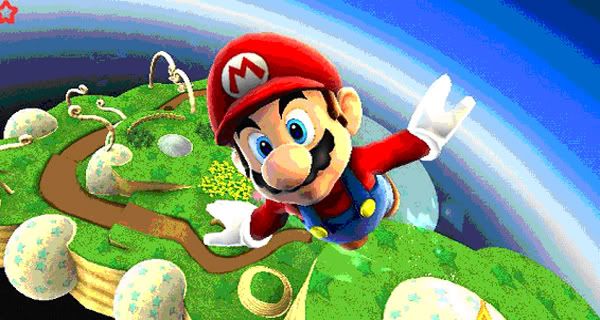
From the birth of videogames to the very finish, Nintendo’s beloved Mario will be present to account for it all.
Works Cited:
McCarthy, David, Ste Curran, and Simon Byron. The Art of Producing Games. Boston: Course PTR, 2005.
Tornquist, Ragnar. RagnarTornquist.com. 03 Oct 2006. 17 Nov 2006 http://ragnartornquist.com/?p=211.
Kelman, Nic. Game Art. New York: Assouline Publishing, 2005.
Smuts, Aaron. "Video Gams and the Philosophy of Art." Aesthetics Online. Aesthetics Online. 17 Nov 2006 http://www.aesthetics-online.org/ideas/smuts.html.
Graft, Kris. "Kojima: 'Games Are Not Art'." Next Generation. 22 Jan 2006. Next Generation. 17 Nov 2006 http://www.next-gen.biz/index.php?option=com_content&task=view&id=2098&Itemid=2.
"I AM 8 BIT." I AM 8 BIT. 4. 17 Nov 2006 http://www.iam8bit.net/.
Smith, David. "Halo 2 In The Sales Record Books." 1UP. 10 Nov 2004. Ziff Davis Media. 17 Nov 2006 http://www.1up.com/do/newsStory?cId=3136413.
Note: The transfer from Word document to an internet post is responsible for the removing of occasional italics and other aspects of the original work. As well as the degradation of picture quality.
This is a catalog of my writing work outside this blog.
Reviews -
GBA - Spider-Man 3 - Modojo
MOB - People's Choice Hangman - Modojo
NDS - Lost in Blue 2 - Modojo
NDS - Wario: Master of Disguise - Modojo
NDS - Lunar Knights - Modojo
NDS - Scurge: Hive - Modojo
NDS - Children of Mana - Modojo
NDS - Cooking Mama - Modojo
NDS - Dragon Quest Heroes: Rocket Slime - Modojo
NDS - Star Fox Command - Modojo
NDS - Bleach: Souten Ni Kakeru Unmei - Modojo
Previews -
NDS - Hoshigami Remix: Ruining Blue Earth - Modojo
NDS - Nervous Brickdown - Modojo
PSP - Dungeon Maker: Hunting Ground - Modojo
NDS - Touchmaster - Modojo
NDS - Planet Puzzle League - Modojo
MOB - The Incredible Machine - Modojo
MOB - Shock Blocks - Modojo
NDS - Naruto: Ninja Council 3 - Modojo
NDS - Rune Factory: A Fantasy Harvest Moon - Modojo
PSP - Valhalla Knights - Modojo
NDS - Death Jr. and the Science Fair of Doom - Modojo
NDS - Sudokuro - Modojo
NDS - Wario: Master of Disguise - Modojo
NDS - Steel Horizon - Modojo
GBA - Yggdra Union - Modojo
NDS - Kirby Squeak Squad - Modojo
NDS - Children of Mana - Modojo
NDS - Magical Starsign - Modojo
NDS - Dragon Quest Heroes: Rocket Slime - Modojo
NDS - Pokemon Mystery Dungeon - Modojo
NDS - Cooking Mama - Modojo
NDS - Star Fox Command - Modojo
GBA - Super Robot Taisen: Original Generation - Modojo
GBA - Summon Night: Swordcraft Story - Modojo
Features -
Puzzle Quest: The Interview (et al) - Modojo
Modojo Roundtable: The Pokemon Incident (et al) - Modojo
Interview: Vicarious Visions (et al) - Modojo
Modojo Roundtable: Puzzle Quest (et al) - Modojo
Demanding More - Handheld Special Editions - Modojo
The DS's Incredible 2007 Potential - Modojo
Handheld Multiplayer: A Comprehensive History - Modojo
Building a Better Handheld - Modojo
Trick or Treat? Modojo's Halloween Handout (et al) - Modojo
Unboxing the X-Boy - Modojo
Help Us, Help You, Sony - Modojo
Mega Man Portable History - Modojo
Japan In My Hand: Best Handheld Imports - Modojo
The GBA Fabulous Fourteen (et al) - Modojo
Modojo Special Report: The State of DS Homebrew - Modojo
Representin' the OG (et al) - Modojo
Coursework -
ENG 202 - Future (Not So) Perfect: Exploring Themes of Dystopia...
ENG 202 - The Lathe of Heaven - Journal Review
ENG 202 - V for Vendetta - Journal Review
ENG 202 - The Iron Heel - Journal Review
ENG 202 - Neuromancer - Journal Review
ENG 202 - The Handmaid's Tale - Journal Review
ENG 202 - Utopia - Journal Review
ENG 202 - 1984 - Journal Review
ENG 102 - Videogames and Art
ENG 101 - The Game of Life
ENG 101 - The Keyboard Zombies
ENG 101 - A Frag Above The Rest
ENG 101 - Star Wars 23: Indiana Jones vs. Superman
Positions Held -
Reviews and Previews Editor - Modojo
Employment: (Lateral Promotion) January 2007 to Current
Wages: N/A
Supervisor: Justin Davis - Editor-in-Chief (justin|at|modojo.com)
Responsiblities:
Maintaining staff writer responsibilities.
Creating a weekly schedule of all published content.
Leading a staff of writers in adhering to scheduled reviews and previews.
Posting and media acquisition for all review and preview content.
Copy editing all review and preview content.
Contacting and building relationships with publishers and developers.
Maintaining the accuracy of a widespread games database.
Creation of a large scale cheats database.
Features Editor - Modojo
Employment: (Promotion) October 2006 to December 2006
Wages: N/A
Supervisor: Justin Davis - Editor-in-Chief (justin|at|modojo.com)
Responsibilities:
Maintaining staff writer responsibilities.
Brainstorming and creation of daily feature content.
Maintaining a schedule of feature content.
Contacting companies and individuals for interviews.
Organizing media for feature content.
Staff Writer - Modojo
Employment: July 2006 to Current
Wages: N/A
Supervisor: Justin Davis - Editor-in-Chief (justin|at|modojo.com}
Responsibilities:
Writing of reviews, previews, and features for handheld games.
Participation in group creation of staff-wide features and interviews.



